
How to vet OEM manufacturers using global supply chain updates

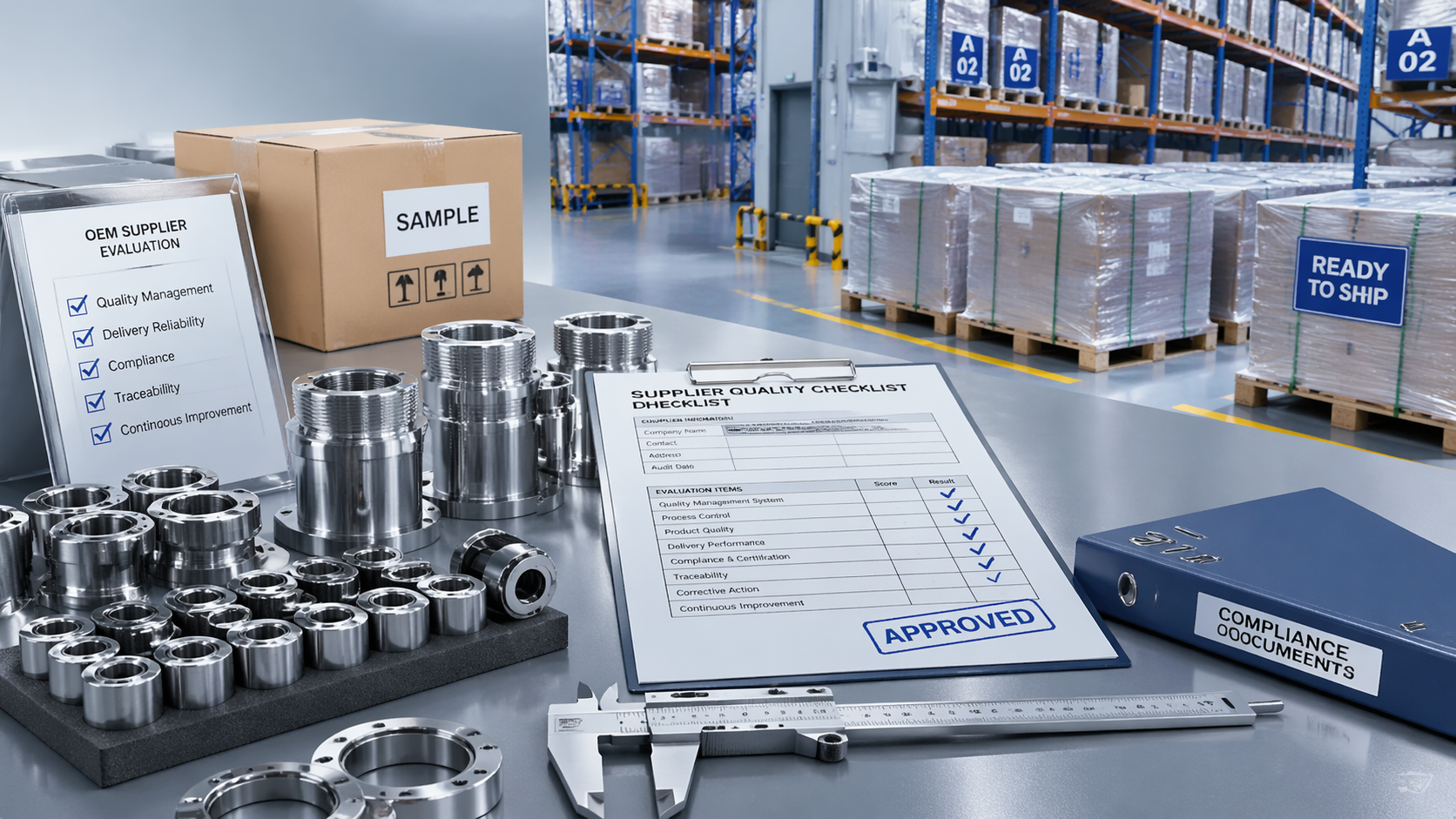
Choosing the right OEM partner starts with timely global supply chain updates for OEM manufacturers. For buyers, operators, and decision-makers, tracking global supply chain updates for reliable suppliers, export trade, and cost-effective solutions helps reduce sourcing risk and improve supplier vetting. This guide shows how to evaluate manufacturers through supply chain intelligence, compliance signals, delivery performance, and market changes before making a long-term sourcing decision.
Why global supply chain updates matter before you shortlist an OEM
Many sourcing failures do not start on the factory floor. They start earlier, when a buyer approves an OEM manufacturer without checking supply chain signals across raw materials, export routes, policy shifts, labor availability, and component continuity. In manufacturing machinery, industrial components, and electrical supplies, a supplier that looks stable in a brochure may still face 2–6 week delays in castings, motors, control parts, or packaging inputs.
Global supply chain updates help information researchers and procurement teams move beyond basic supplier directories. Instead of judging only by company age or website quality, they can compare whether the manufacturer is operating in a region with freight congestion, energy restrictions, customs changes, or volatile commodity pricing. That wider view is often what separates a low-risk OEM partner from a future disruption point.
For operators and end users, the impact is practical. If spare parts, electrical assemblies, bearings, sensors, or fabricated frames arrive late, downtime can expand from 48 hours to several weeks. For business decision-makers, the same delay affects contract commitments, inventory cost, and customer satisfaction. This is why supply chain intelligence should be part of supplier vetting before samples, audits, or annual agreements are finalized.
A strong portal that tracks industry news, market analysis, price trends, technology updates, policy interpretation, exhibition activity, export trade developments, and supply chain intelligence gives buyers a more realistic basis for OEM evaluation. It helps teams connect external changes with internal sourcing decisions instead of treating procurement as a one-time price comparison exercise.
What should you monitor in the first screening stage?
In the first 7–10 days of screening, focus on signals that affect continuity rather than only catalog breadth. A manufacturer may offer 50 product lines, but if critical subcomponents come from a single high-risk source, the practical supply reliability is much lower than it appears.
- Check raw material exposure, especially for steel parts, copper content, electronic components, motors, insulation materials, and precision machined items with long replenishment cycles.
- Review export route stability, including port congestion, container availability, customs efficiency, and inland transport from plant to port or border terminal.
- Watch policy and compliance updates that may affect labeling, safety documentation, restricted substances, energy efficiency, or market entry conditions.
- Track production continuity indicators such as plant expansion news, equipment upgrades, hiring activity, and recurring exhibition participation, which often signal operational momentum.
If these indicators are stable for at least 2–3 consecutive review points, the OEM is usually worth moving into deeper technical and commercial evaluation. If several indicators deteriorate at once, buyers should either reduce exposure or request contingency planning before proceeding.
How to vet OEM manufacturers: a practical supplier assessment framework
A useful vetting process should be modular, repeatable, and relevant to B2B sourcing. In cross-border manufacturing and industrial procurement, a good framework usually covers 5 core dimensions: capability, supply continuity, quality control, compliance readiness, and delivery execution. This approach works across machinery assemblies, industrial components, and electrical equipment because it evaluates both factory strength and external risk exposure.
The goal is not to find a perfect supplier. The goal is to identify whether an OEM can meet your required output, specification consistency, and delivery window under changing market conditions. For example, a supplier with slightly higher unit pricing may be the better choice if it maintains shorter replenishment cycles, clearer engineering communication, and stronger alternative sourcing channels.
Procurement teams should also score each candidate using the same review logic. Without a unified structure, internal discussions often become subjective. One team focuses on price, another on sample finish, while management worries about export risk. A score-based framework allows comparison across 3–5 shortlisted OEM manufacturers without losing critical detail.
Key dimensions for OEM manufacturer vetting
The table below summarizes a practical assessment structure for evaluating OEM manufacturers with support from global supply chain updates. It is especially relevant for industrial buyers comparing suppliers for repetitive orders, custom assemblies, or long-term contract manufacturing.
This framework helps turn supply chain updates into sourcing decisions. Instead of reading market information passively, buyers can connect each update to a specific verification action. That is the difference between information overload and useful supplier intelligence.
A 4-step vetting workflow for procurement teams
- Pre-screen 8–12 suppliers using public trade, market, and supply chain signals to remove weak candidates early.
- Shortlist 3–5 OEM manufacturers and request lead time ranges, process descriptions, document samples, and key material sourcing details.
- Run a trial order or sample validation with defined inspection items, packaging rules, and delivery checkpoints over 2–4 weeks.
- Approve long-term cooperation only after quality consistency, communication speed, and logistics stability meet internal thresholds.
This workflow reduces the common mistake of moving directly from quotation to contract. In industrial procurement, the cheapest first quote often becomes the most expensive sourcing path when rework, delay, or replacement costs are included.
What buyers should compare beyond price and sample quality
Price and sample appearance are important, but they are incomplete. A polished sample can be prepared manually, while mass production exposes the real strength of process control, material continuity, and shipment discipline. For OEM manufacturers, the buyer should compare not only unit cost but also total sourcing resilience across the full order cycle.
This is especially important in sectors covered by manufacturing and processing machinery, industrial equipment and components, and electrical equipment and supplies. Here, a late connector, enclosure, motor, fastener, PCB-related part, or machined housing can interrupt larger assemblies. The indirect cost of one weak supplier can be much higher than a 3%–8% unit price difference.
Buyers should compare lead time reliability, engineering response, minimum order flexibility, packaging suitability for export, and post-shipment document support. For decision-makers, that creates a more accurate total cost picture and supports supplier segmentation into primary, backup, and development partners.
Comparison table for OEM sourcing decisions
The following table can be used during supplier selection meetings. It compares common sourcing criteria that often matter more than headline pricing when evaluating OEM manufacturers using global supply chain updates.
Used correctly, this comparison method helps teams move from “Who is cheapest?” to “Who can deliver reliably under current supply chain conditions?” That is a more useful question for industrial sourcing, especially when replacement suppliers are costly to qualify.
Typical sourcing scenarios and what to prioritize
Not every buyer should evaluate OEM manufacturers in the same way. The right emphasis depends on order type, product complexity, and the cost of disruption in your downstream operation.
- For small-batch custom projects, prioritize engineering communication, drawing control, and sample turnaround over unit price.
- For repeat production orders, prioritize lead time stability, packaging consistency, and backup material options.
- For electrical assemblies or export-sensitive products, prioritize documentation readiness, labeling accuracy, and destination-market compliance support.
- For urgent replacement sourcing, prioritize available capacity in the next 2–3 weeks and realistic shipment planning rather than broad product range claims.
This scenario-based method is useful for information researchers, operators, buyers, and executives because it aligns supplier evaluation with actual business outcomes instead of generic sourcing checklists.
How to review compliance, documentation, and export readiness
A manufacturer can have acceptable pricing and workable production capacity, yet still create problems if compliance files and export documents are weak. In industrial and electrical supply chains, non-product risks often appear in technical declarations, labeling errors, shipping marks, packaging choices, and inconsistent record keeping. These issues can delay customs clearance, warehouse receiving, installation approval, or customer acceptance.
Buyers should therefore verify documentation readiness early, ideally before the first trial order. A practical review includes product specifications, drawings, inspection criteria, packaging details, origin-related documents where needed, and destination-market technical requirements. If a supplier needs repeated reminders to assemble basic files, that is already a warning sign for future execution quality.
In many cases, OEM manufacturers are not expected to hold every market approval themselves for every product category. However, they should be able to explain what files they can provide, what testing may be needed, and which responsibilities belong to the buyer, importer, or final brand owner. Clear boundaries reduce confusion and speed up project planning.
A practical compliance checklist for cross-border sourcing
The most effective approach is to verify 6 key document areas before scale-up. This is not about chasing unnecessary paperwork. It is about confirming whether the OEM manufacturer can support repeatable export execution.
Six items to confirm before mass orders
- Product specification alignment, including dimensions, rated parameters, tolerances, materials, and revision control for drawings or BOMs.
- Inspection and acceptance criteria, such as visual checks, functional tests, packaging checks, and key measurement points.
- Labeling and marking details, including model references, carton marks, safety labels, and country-specific information if applicable.
- Export document timing, especially commercial invoice, packing list, shipping marks, and any agreed technical files needed before dispatch.
- Packaging suitability for transit periods of 15–45 days, depending on route, climate exposure, and warehouse handling conditions.
- Change notification rules, including how many days in advance the supplier must alert the buyer to material, process, or component changes.
This checklist is especially valuable when market updates suggest rising compliance pressure or changing import procedures. It allows procurement teams to convert policy interpretation and trade intelligence into concrete supplier controls.
Common mistakes, FAQ, and the next step for better OEM decisions
The most common mistake in OEM sourcing is assuming that a qualified sample equals a qualified long-term manufacturer. In reality, supplier vetting should continue through quoting, sampling, pilot production, shipment, and post-delivery review. Another common error is separating market intelligence from procurement execution. When supply chain updates are ignored, teams often react too late to freight shifts, policy changes, or input shortages.
A better approach is to treat global supply chain updates as an ongoing operating input. Review them monthly for stable categories and weekly for volatile categories. If your sourcing involves electrical items, fabricated machinery parts, or multi-component assemblies, even one update cycle can reveal whether a supplier’s risk profile is improving or weakening.
The questions below address common search intent from researchers, operators, procurement staff, and decision-makers who need practical guidance when screening OEM manufacturers in dynamic global markets.
How many OEM manufacturers should I shortlist?
For most industrial sourcing projects, 3–5 serious candidates are enough after an initial market scan. Fewer than 3 limits negotiation and risk comparison. More than 5 often slows evaluation without improving decision quality, unless the category is highly customized or the supply market is fragmented.
How long should supplier vetting take before placing a larger order?
A practical cycle is 2–6 weeks, depending on product complexity and documentation needs. Simple industrial components may be screened faster. Custom machinery parts or electrical assemblies usually require more time for drawing review, sampling, compliance file checks, and shipment planning validation.
What if a supplier offers the lowest price but has unstable lead times?
Treat unstable lead time as a cost factor, not just a logistics issue. Delays can create premium freight, line stoppage, emergency purchasing, or contract penalties. If the supplier cannot explain lead time drivers, buffer stock policy, or alternative sourcing methods, the lower quotation may not represent the lower total landed cost.
Which signals suggest an OEM manufacturer is worth long-term development?
Look for consistent communication within 24–72 hours, realistic delivery windows, willingness to clarify process details, organized documentation, and evidence that the company responds to market changes rather than hiding them. Suppliers that openly discuss constraints and solutions are often better long-term partners than those who promise everything immediately.
Why choose us for OEM sourcing intelligence and supplier vetting support?
We focus on the industrial sectors where supplier selection is closely tied to manufacturing reality: manufacturing and processing machinery, industrial equipment and components, and electrical equipment and supplies. Our content coverage connects industry news, market analysis, price trends, technology updates, policy interpretation, company news, exhibition coverage, export trade developments, and supply chain intelligence, so buyers can see not only who supplies, but also what may affect delivery, compliance, and cost.
If you are comparing OEM manufacturers, you can contact us for practical support on supplier screening logic, product selection checkpoints, delivery cycle evaluation, documentation review priorities, customization discussion points, and quotation comparison methods. This is useful whether you are confirming specifications, planning a trial order, checking certification-related documents, requesting sample support, or narrowing a supplier list for management approval.
When your team needs clearer sourcing decisions, stronger supplier vetting, and more timely global supply chain updates, a structured intelligence-driven process can reduce avoidable risk before contracts are signed. That is where better information becomes better procurement.


Industry Briefing
Get the top 5 industry headlines delivered to your inbox every morning.