
How to spot reliable suppliers before supply risks escalate

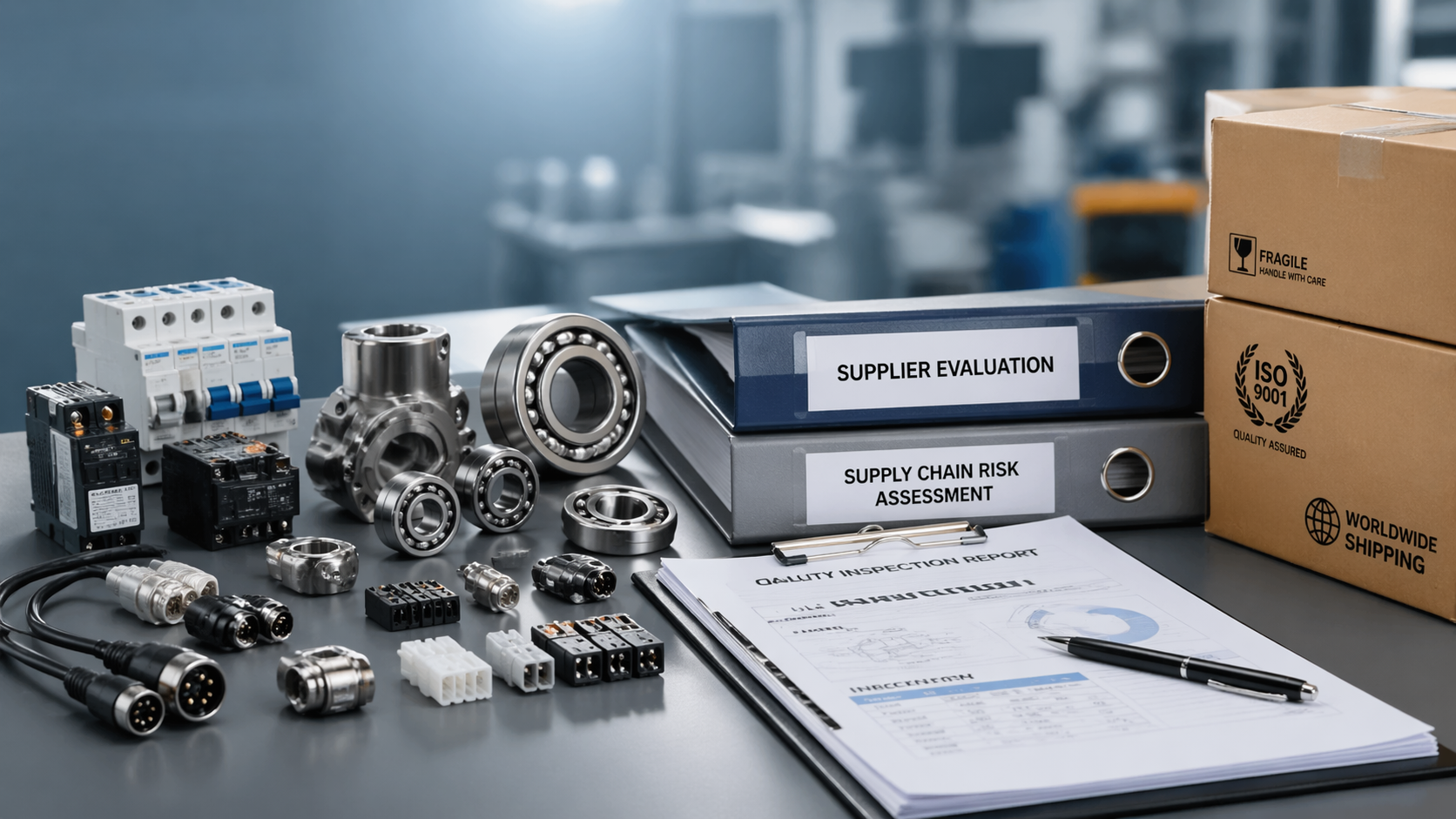
Supply risks rarely appear overnight—they build through weak visibility, poor vetting, and delayed response. For buyers and decision-makers, using global supply chain updates for reliable suppliers and global supply chain updates for risk management is essential to verify credibility early. This article explains how to spot dependable partners faster, using secure global supply chain updates, supplier signals, and practical checks that support cost-effective solutions before disruptions escalate.
In manufacturing and processing machinery, industrial equipment components, and electrical supplies, a supplier problem can move from a minor delay to a major production loss in 7–30 days. For procurement teams, plant operators, market researchers, and executives, the real challenge is not only finding suppliers, but filtering out unstable ones before quality issues, customs delays, or contract disputes affect output.
Reliable supplier identification now depends on a mix of operational evidence, commercial discipline, and continuous supply chain intelligence. A factory may look capable on paper, yet still fail under pressure if its upstream sources are concentrated, its lead times are inconsistent, or its communication breaks down when demand rises by 15%–20%. Early screening reduces these risks and improves sourcing resilience.
Why supplier reliability must be verified before the first order
A low quoted price is rarely enough in B2B sourcing. In machinery, industrial components, and electrical equipment, the total cost of supplier failure can include line stoppages, emergency freight, inspection rework, warranty claims, and delayed customer delivery. A component that is 8% cheaper may become 25% more expensive if it arrives 2 weeks late or fails incoming inspection.
Supplier reliability should be assessed before sample approval, before tooling commitment, and before annual framework agreements. This timing matters because switching vendors after mold development, packaging setup, or compliance filing can add 30–90 days to a project. For decision-makers, early risk control protects both budget stability and business continuity.
In cross-border sourcing, risk usually shows up through small warning signs. These may include unusually fast quotation turnaround without technical clarification, repeated changes in delivery promises, or a refusal to provide production references. None of these signals alone proves a supplier is unreliable, but 3–4 weak signals together should trigger deeper verification.
For operators and procurement professionals, it helps to classify reliability into four dimensions: production capability, quality consistency, commercial responsiveness, and supply chain transparency. A supplier that scores well in only one area is still a weak partner. Long-term sourcing success depends on balanced performance across all four.
The cost of late supplier screening
Late vetting often happens when buyers focus on product specifications first and supplier systems second. In practice, a stable quality document package, a clear escalation path within 24 hours, and evidence of repeated export deliveries can matter as much as the part drawing itself. This is especially true for motors, switchgear parts, castings, machined housings, bearings, connectors, and control assemblies.
Typical consequences of weak verification
- Sample quality differs from mass production because process control was not reviewed.
- Lead time extends from 20 days to 45 days once peak season starts.
- Material substitutions appear without prior approval, affecting durability or compliance.
- Communication slows after deposit payment, delaying corrective action.
The table below outlines how early-stage supplier checks reduce common sourcing losses in industrial trade environments.
The key takeaway is that reliability is measurable before purchase orders scale. Buyers who verify process, capacity, and communication systems in advance are usually better positioned to absorb market volatility without sudden supply disruption.
Supplier signals that reveal stability, risk, or hidden weakness
A reliable supplier leaves operational evidence. This does not always mean large size or famous branding. In industrial markets, a medium-sized factory with disciplined planning, transparent sourcing, and consistent response can be safer than a larger vendor with overloaded capacity. Buyers should therefore focus on signals that connect directly to execution quality.
One of the strongest positive signals is consistency across documents. If quotation terms, sample timing, packaging detail, and quality checkpoints align over 2–3 communication rounds, the supplier is more likely to have internal control. When details shift repeatedly, such as MOQ changing from 500 units to 2,000 units without explanation, that inconsistency may reflect weak planning or outsourced dependency.
Another signal is the depth of technical discussion. Dependable suppliers ask for drawings, operating conditions, voltage range, tolerance targets, duty cycle, or installation environment. For example, an electrical equipment supplier should clarify whether the application is indoor or outdoor, 50Hz or 60Hz, and whether IP rating or thermal performance matters. A vendor that skips these questions may be quoting without real engineering alignment.
Supply chain visibility is equally important. Buyers should ask how many approved raw material sources the supplier uses, whether key components come from one country or several, and what backup arrangements exist. If 70%–80% of critical materials depend on a single upstream source, even a financially healthy supplier may still be vulnerable to logistics shocks or policy changes.
Positive and negative indicators to watch
- Positive: clear process flow, named quality contact, stable lead time history, and willingness to share inspection checkpoints.
- Positive: realistic production window such as 25–35 days instead of an overly aggressive promise that ignores peak season constraints.
- Negative: unclear factory role, frequent claims of “ready stock” for specialized industrial parts, or resistance to pre-shipment verification.
- Negative: heavy discounting tied to immediate deposit pressure without enough technical review.
Use updates, not snapshots
Many sourcing mistakes come from evaluating suppliers once and then assuming conditions remain stable for 6–12 months. In reality, labor turnover, policy adjustments, shipping congestion, and commodity volatility can change performance quickly. Global supply chain updates for reliable suppliers are most useful when they are monitored continuously, especially before repeat orders, seasonal demand peaks, or new product launches.
For industrial buyers, monthly or quarterly review is often more practical than one-time approval. A supplier approved in Q1 may face upstream shortage in Q3. Monitoring updates on export flow, exhibition activity, policy interpretation, and company news helps buyers detect change before it becomes an operational failure.
A practical vetting framework for procurement and sourcing teams
The most effective supplier screening process is structured, repeatable, and fast enough to support commercial decisions. In many B2B sourcing environments, a 5-step framework can identify major risks within 7–10 working days, without waiting for a full audit. This approach is useful for standard components, custom mechanical parts, electrical assemblies, and equipment sub-systems.
Step-by-step review process
- Supplier profile check: verify business scope, export relevance, product focus, and communication ownership.
- Technical fit review: confirm drawing interpretation, material grade, power rating, tolerance level, and application conditions.
- Operational proof: request production photos, process checkpoints, packaging method, and recent shipment examples.
- Commercial risk review: compare payment terms, lead-time buffer, MOQ flexibility, and after-sales handling path.
- Pilot order validation: place a controlled first order with measurable acceptance criteria and defined response times.
Pilot orders are especially valuable because they convert claims into observed performance. A first order of 5%–15% of planned quarterly volume is often enough to test packaging quality, transit readiness, inspection consistency, and problem resolution speed. This is safer than starting with full allocation before supplier behavior has been proven.
Procurement teams should also score suppliers using weighted criteria. For example, price may account for 25%, technical alignment 25%, delivery stability 20%, quality systems 20%, and communication discipline 10%. Different categories require different weights: for safety-relevant electrical parts, quality and compliance may need to exceed price in decision importance.
The comparison table below can be used as a practical scoring reference when shortlisting industrial suppliers.
This framework helps buyers avoid emotional decisions based on price alone. It also creates a common evaluation language between procurement staff, plant teams, and senior management, which is essential when sourcing decisions affect production continuity and customer delivery commitments.
How to use supply chain intelligence to reduce disruption risk
Supplier reliability is not only about the supplier itself. It is also about the environment around it. Secure global supply chain updates help buyers understand changes in trade routes, raw material availability, policy interpretation, exhibition signals, and export market movement. These updates can reveal whether a supplier’s promises remain realistic under changing conditions.
For example, if a machinery component supplier depends on imported alloy steel, then commodity price movement and customs processing changes may affect the supplier’s lead time by 10–20 days. If an electrical equipment vendor relies on one region for connectors or insulation materials, local logistics pressure can influence delivery even when the factory itself is operating normally.
This is why global supply chain updates for risk management should be linked with supplier review records. Buyers should not keep market analysis and procurement approval in separate silos. When market intelligence and supplier monitoring work together, sourcing teams can update safety stock, alternate sourcing plans, and delivery schedules before risks escalate into missed shipments.
What to monitor regularly
- Raw material trend changes that could impact castings, copper-based electrical parts, sheet metal, plastics, or electronic subcomponents.
- Export trade developments that affect customs clearance, freight availability, and regional routing.
- Company news such as capacity expansion, management change, or product line shift.
- Exhibition participation and technology updates that may signal capability growth or market repositioning.
Set review intervals by category
Different products need different monitoring frequency. For standard fasteners or non-critical accessories, a quarterly review may be enough. For motors, drive parts, switch components, sensors, or custom-machined items with 30–60 day lead times, monthly review is more practical. High-impact categories deserve closer monitoring because the replacement cycle is longer and qualification takes more effort.
An effective rule is to review more often when any of these thresholds are met: annual spend exceeds a meaningful share of category budget, delivery lead time exceeds 4 weeks, a part has no approved second source, or field failure would stop production. These thresholds help management focus effort where disruption cost is highest.
Common mistakes buyers make when choosing industrial suppliers
One common mistake is confusing responsiveness with capability. Fast replies can create confidence, but speed alone does not prove production control, engineering depth, or stable upstream sourcing. In industrial categories, buyers should ask whether the supplier can repeat performance over 3, 6, or 12 months, not just whether they reply within 2 hours.
Another mistake is approving a supplier based only on samples. Samples may be manually selected or produced under special conditions. Without process control review, sample approval does not guarantee mass-production consistency. This is why incoming inspection plans, batch traceability, and packaging standards should be discussed before order expansion.
A third mistake is ignoring logistics and documentation capability. In export-oriented supply chains, shipping marks, carton structure, pallet logic, and commercial documents can influence delivery as much as factory output. Even technically capable suppliers can create avoidable delays if their export handling discipline is weak.
Finally, buyers sometimes fail to define what acceptable performance means. A supplier cannot be managed well if there is no clear target for on-time delivery, defect threshold, response time, or claim resolution window. Setting these metrics early creates a factual basis for review instead of relying on subjective impressions.
A simple checklist before supplier approval
- Confirm whether quoted lead time includes production, testing, packaging, and dispatch preparation.
- Ask how many critical raw material sources are approved and what happens if one fails.
- Review how nonconforming goods are reported and corrected within 24–72 hours.
- Check whether packaging matches transport distance, handling method, and product fragility.
- Define a pilot order volume and acceptance criteria before moving to regular orders.
FAQ: questions buyers often ask
The questions below reflect common search intent from procurement teams and industrial decision-makers who want a practical way to identify reliable suppliers before risks grow.
How long should supplier vetting take?
For standard industrial products, an initial screening can often be completed in 7–10 working days. For custom machinery parts, electrical assemblies, or products with compliance requirements, 2–4 weeks is more realistic because technical review, sample checks, and documentation verification take longer.
What matters more: price or lead-time stability?
For non-critical items, price may carry more weight. For production-critical components, lead-time stability usually matters more because the cost of downtime can exceed the unit price difference very quickly. Many buyers therefore use a blended model where total landed cost and continuity risk are reviewed together.
Should one good order be enough to trust a supplier?
No. One successful shipment proves basic capability, but not necessarily long-term reliability. A more practical benchmark is stable performance across at least 3 order cycles, including one period of higher demand or tighter schedule pressure. That gives a better view of consistency.
What if a supplier refuses to share operational detail?
Some confidentiality limits are normal, but total lack of transparency is a warning sign. If a supplier cannot explain process steps, quality controls, delivery planning, or issue handling at a reasonable level, buyers should reduce order exposure, request a pilot order only, or continue supplier benchmarking before commitment.
Spotting reliable suppliers before supply risks escalate requires more than a price comparison. It depends on reading supplier signals, testing claims through structured vetting, and combining supplier review with ongoing supply chain intelligence. In manufacturing machinery, industrial components, and electrical equipment sourcing, that discipline reduces delays, protects quality, and supports more confident purchasing decisions.
If you need deeper industry news, market analysis, price trend tracking, policy interpretation, exhibition updates, or supply chain intelligence to support smarter supplier selection, now is the right time to act. Contact us to explore tailored sourcing insights, evaluate supplier risk more effectively, and learn more solutions for resilient industrial procurement.



Industry Briefing
Get the top 5 industry headlines delivered to your inbox every morning.
- industrial equipment
- manufacturing machinery
- equipment sourcing
- industrial components
- machinery parts
- supply chain
- procurement
- manufacturing
- global supply chain updates
- global supply chain updates for risk management
- secure global supply chain updates
- global supply chain updates for reliable suppliers