
Deep Groove Ball Bearings: Read More Than the Number

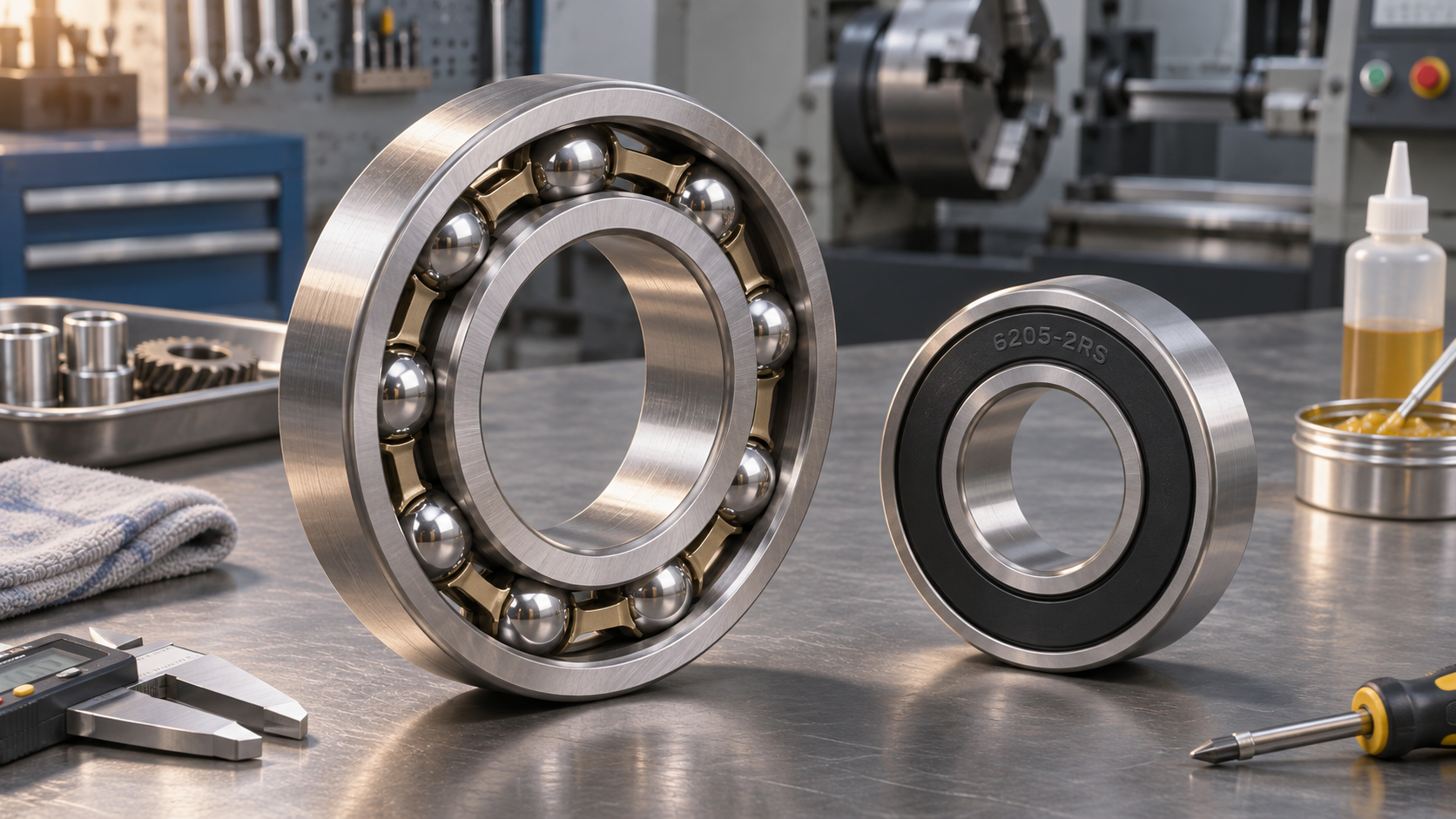
A small bearing can stop a large machine, yet its purchase often starts with only a number copied from an old ring. That number is useful. It is rarely the complete specification. Two bearings with matching boundary dimensions can behave differently because their seals, internal clearance, cage, lubricant, or manufacturing tolerances differ. Understanding those differences gives maintenance staff and new buyers a better starting point than comparing package labels alone.
This guide explains deep groove ball bearings through the questions people encounter on an actual equipment list: what the bearing supports, what its markings reveal, why apparently similar versions differ, and what information belongs in a replacement request. The goal is a usable vocabulary for conversations between purchasing, maintenance, and engineering.
Begin with the path of the load
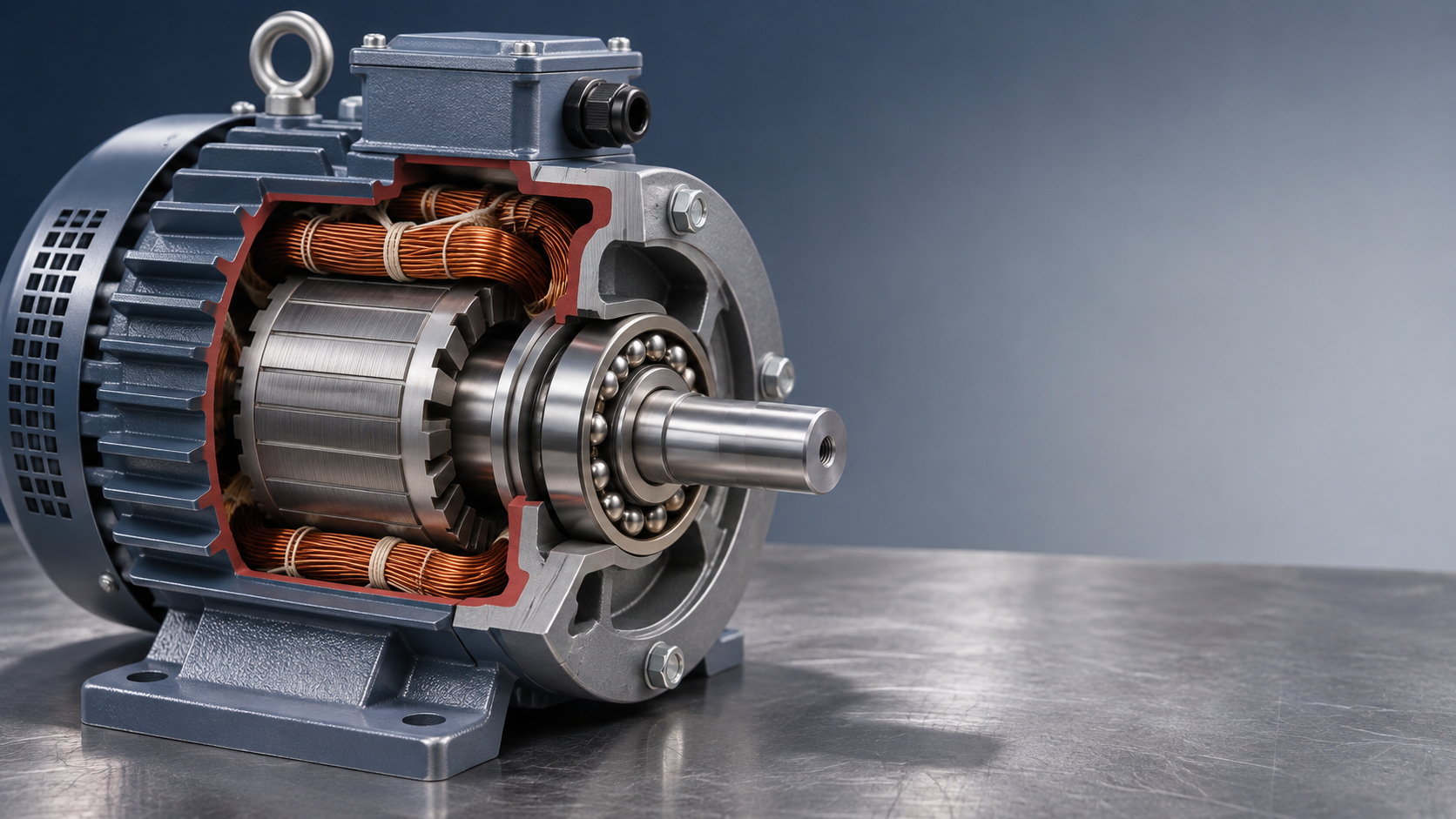
Inside the assembly, balls roll between raceways in an inner ring and an outer ring. A cage separates and guides the balls. The curved raceways allow the bearing to support radial loads and, within design limits, axial loads in either direction. That combination explains its presence in motors, fans, pumps, small gearboxes, and many other rotating assemblies.
Radial load acts across the shaft. Axial load acts along it. A belt driving a shaft introduces a radial force, while a machine mechanism may also generate thrust. Actual bearing selection considers the combination, its direction, its variability, and the way the shaft is supported elsewhere. The phrase “handles both loads” does not mean unlimited thrust capacity.
The support arrangement matters just as much as the individual component. A shaft may need one bearing position to locate it axially and another position to accommodate thermal movement. If both positions unintentionally restrain expansion, the assembly can develop loads that were absent from the original calculation. Buying a larger bearing does not automatically correct that arrangement.
What the familiar number tells you
Bearing designations provide information about type, size series, and bore, but interpretation requires the relevant manufacturer's designation system. For many common metric series, a bore code follows a familiar pattern. Exceptions exist, including small sizes and special bores. Reading the manufacturer's catalog is safer than applying a remembered arithmetic rule to every product.
Suffixes are especially important. They may describe shields, contact seals, increased clearance, a cage variant, accuracy, lubrication, or a special construction. Similar suffixes used by different brands are not guaranteed to identify identical performance. Ask the supplier to translate the complete designation into plain specifications before approving an alternative.
Record dimensions independently where possible. Bore, outside diameter, width, corner radius, and the available shoulder geometry determine whether the component can be mounted properly. A matching bore alone leaves too many unanswered questions. A usable purchase request includes the complete original marking, measured dimensions, photographs, and the machine location.
Open, shielded, and sealed versions
An open bearing leaves the rolling elements accessible to an external lubrication system. This can suit an oil-lubricated housing, provided the surrounding arrangement controls contamination. Open construction should be considered as part of that housing system rather than as an inexpensive substitute for a protected bearing.
Metal shields usually create a small noncontact gap. They help retain grease and limit some contamination while generally contributing little seal friction. They do not establish a waterproof barrier. In dusty or wet service, the housing protection and operating conditions remain important.
Contact seals offer another balance. Their lips can improve exclusion of contaminants, but friction, temperature, speed, and material compatibility affect suitability. Noncontact and low-friction seal designs create further variations. The correct comparison asks what contaminant must be excluded, how it reaches the bearing, and how much drag the application can accept.
Clearance is a working allowance
Internal clearance describes relative movement between the rings before or after mounting, depending on the measurement context. Fits and temperature change the clearance available in operation. Pressing an inner ring onto a shaft can expand that ring. A warmer inner ring can also reduce the available operating clearance relative to the outer ring.
An increased-clearance designation therefore does not simply mean “higher quality” or “looser manufacture.” It identifies a design allowance that may be needed for particular fits and operating temperatures. Conversely, choosing increased clearance without a reason can undermine noise or vibration objectives. The equipment maker's specification is the first reference.
When an original bearing repeatedly runs hot, avoid changing clearance by guesswork. Check shaft and housing dimensions, roundness, alignment, loading, lubrication quantity, and the temperature pattern. A clearance change belongs in an engineering review that explains the mechanism being corrected and the evidence needed to confirm success.
Speed belongs to an operating condition
Catalog speed values are not universal permission to run at that speed in every assembly. Bearing size, lubrication method, load, seals, cage, cooling, and accuracy influence the available operating range. A speed quoted for an open oil-lubricated design may be unsuitable for a sealed grease-filled variant of similar dimensions.
Ask which conditions support a supplier's speed statement. Is the figure a reference speed, a limiting speed, or an application recommendation? What lubricant and mounting conditions are assumed? Those questions make quotations comparable and reduce the risk of approving a part on the basis of an isolated headline number.
Low-speed operation also deserves attention. Heavy load, vibration while stationary, and repeated small movements can create damage mechanisms that a high maximum-speed figure does not address. A bearing can be comfortably below its speed limit and still be unsuitable for the machine's actual duty.
Lubrication is part of the specification
Lubricant forms a separating film, reduces wear, and affects temperature. Its base-oil viscosity, thickener, additives, and service range need to suit the application. A grease described as high temperature may still be inappropriate for a fast small bearing or for a machine exposed to a particular cleaning chemical.
More grease is not always better. Excessive filling can increase churning and heat, especially at higher speeds. Too little lubricant or interrupted oil delivery can also cause failure. Follow the machine and bearing manufacturer's instructions, including any distinction between initial fill and replenishment quantities.
Do not mix unfamiliar greases casually. Compatibility involves more than matching color or a broad consistency grade. Record the existing lubricant and obtain a compatibility assessment before introducing another product. For sealed bearings supplied with grease, confirm whether relubrication is intended at all and how storage conditions affect the supplied assembly.
Build a replacement request people can use
A good request begins with the equipment role. Describe the machine, shaft position, speed range, load source, environment, and failure history. Include the full designation and explain whether the request concerns a routine replacement, a dimensional substitute, or an attempt to improve reliability. These are different engineering tasks.
The site's deep groove ball bearings category provides a product-family starting point for an inquiry. The next step is obtaining the drawing and the exact construction offered for the intended duty. A category listing establishes product availability at a broad level; it does not establish suitability for a specific motor or production line.
A practical request should also identify required records: dimensional data, clearance designation, seal construction, lubricant, packaging, and traceability. Agree which characteristics will be checked on receipt. For a replacement involving a new supplier, inspect samples and validate operation before treating the purchase as a repeatable specification.
FAQ: three misunderstandings to clear up
Does a quieter bearing always last longer?
Noise can reveal problems, but quiet operation is not a standalone life guarantee. Measurement method, speed, load, lubrication, and background vibration affect the result. Ask what noise or vibration requirement applies to the machine and how it will be measured. Compare results under equivalent conditions rather than relying on a hand-spin demonstration.
Can the original seals be removed to reduce heat?
Removing a seal changes contamination protection and lubricant retention. It can also damage the bearing during handling. If seal friction is suspected, review the temperature and operating conditions with engineering and the supplier. A correctly specified alternative is preferable to modifying a purchased assembly without a defined validation plan.
Is matching the outside size enough for interchangeability?
No. Internal design, load ratings, clearance, accuracy, corner geometry, seals, and lubricant can still differ. Interchangeability is a documented conclusion about the complete requirement. For critical machines, retain an approved substitution record so future orders do not repeat the original uncertainty.
Turn the number into a specification
One useful exercise is to review a recent purchase request before the next breakdown. Ask a colleague who did not place the order to identify the exact required construction from the record. If that person must guess the seal, lubricant, clearance, or application, improve the record now. The exercise exposes missing information while there is time to obtain it from drawings, equipment manuals, or the supplier.
Keep commercial and engineering descriptions connected. A stock code may be convenient for the purchasing system, but it should lead to the controlled technical requirement and its approved alternatives. If the supplier changes a suffix, request an explanation before accepting the shipment. This small habit prevents shorthand developed for ordering from becoming an accidental permission to change the machine specification.
The useful habit is simple: preserve the complete marking, describe the operating conditions, and request the missing details. That turns a bearing number into a specification people can inspect and repeat. It also makes supplier discussions more productive because the conversation concerns a defined machine duty rather than an assumed equivalence.
Keep the result with the equipment record. Include the approved part, drawing revision, lubricant, fitting instructions, and any acceptance measurements. The next maintenance team can then replace the bearing using documented knowledge instead of reconstructing the decision from a worn ring and an old invoice.
 Deep Groove Ball Bearings: Read More Than the NumberTime : Nov 07, 2026
- Selecting Low Noise Bearings: Key Factors for Electric MotorsTime : Nov 04, 2026
- Choosing Electric Motor Bearings: Speed, Load and Lubrication FactorsTime : Nov 01, 2026

Industry Briefing
Get the top 5 industry headlines delivered to your inbox every morning.