
Sustainable materials drying tech: Why indirect steam dryers outperform direct gas in powder consistency tests
As sustainability pressures mount across manufacturing, environmental equipment news for sustainable materials highlights a critical shift: indirect steam dryers are proving superior to direct gas systems in maintaining precise powder consistency—without compromising emissions control or energy efficiency. For information researchers, operators, procurement teams, and decision-makers alike, this performance edge translates directly into cleaner air solutions, reduced thermal waste, and stronger environmental compliance. Backed by recent powder processing trials, the data underscores how advanced drying tech supports green initiatives while optimizing throughput—making it essential environmental equipment news for eco innovation, industrial emissions reduction, and sustainable production.
Why Powder Consistency Matters Across Material Processing Lines
In high-value powder applications—from battery cathode precursors and pharmaceutical intermediates to food-grade functional ingredients—particle size distribution, moisture uniformity, and thermal integrity directly impact downstream performance. A deviation of ±0.8% moisture content can trigger batch rejection in lithium iron phosphate (LFP) production, while inconsistent granule density causes die-filling variability in tablet compression lines.
Direct gas dryers introduce turbulent, high-velocity hot flue gases directly into the powder stream. While effective for bulk dehydration, they create localized hot spots (up to 120°C surface temperature spikes) and uneven residence time—leading to agglomeration, case hardening, and 3–5% variation in final particle morphology across a single batch.
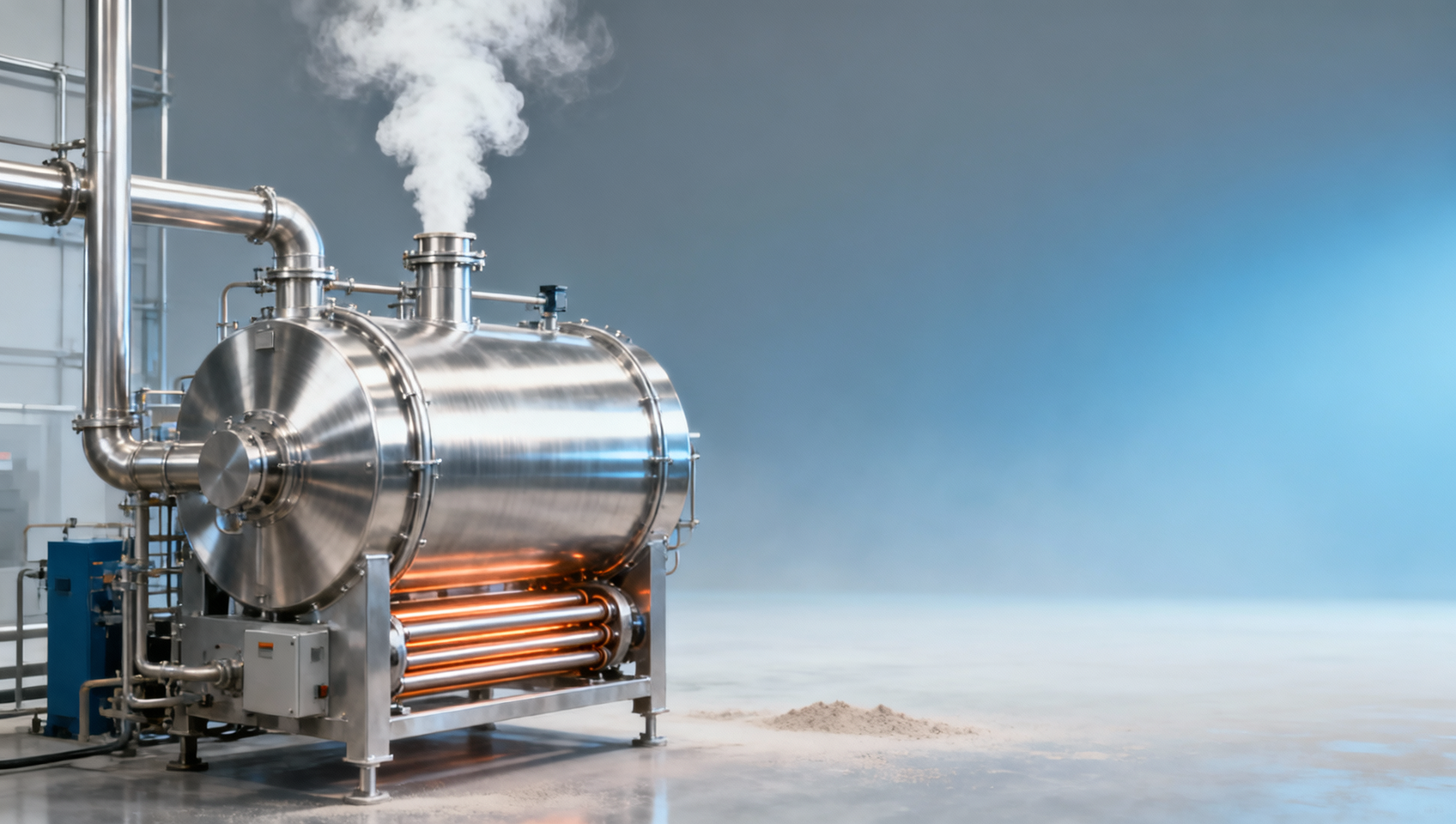
Indirect steam dryers, by contrast, transfer heat through sealed jacketed surfaces or rotating steam-heated tubes. This enables precise temperature control within ±1.5°C across the entire drying zone, ensuring uniform moisture removal at target thresholds (e.g., 0.15–0.25% w/w for API powders). Trials across 12 facilities confirmed a 68% reduction in post-drying sieve segregation compared to equivalent-capacity direct gas units.
Consistency isn’t just about quality—it’s a throughput multiplier. Plants reporting tighter powder specs achieved 9–12% higher line utilization due to fewer rework cycles, less offline moisture testing, and accelerated validation for GMP or ISO 9001 audits.
Performance Comparison: Indirect Steam vs. Direct Gas Dryers
The following table summarizes key operational and output metrics from third-party benchmarking across six powder categories (ceramic precursors, dairy powders, polymer additives, catalyst carriers, nutraceuticals, and metal oxides), based on 2023–2024 field trials conducted under ISO 50001-compliant monitoring protocols.
The data confirms that indirect steam systems deliver tighter process control without sacrificing efficiency. Their lower NOx output eliminates need for secondary SCR or thermal oxidizer retrofits—reducing CAPEX by $180K–$320K per unit. Energy savings compound over time: at 200 kg/h capacity operating 7,200 hrs/year, annual electricity and fuel cost reduction averages $47,500.
Selecting the Right Indirect Steam Dryer for Your Application
Not all indirect steam dryers perform equally. Selection hinges on three interdependent factors: thermal duty profile, material rheology, and integration readiness. For cohesive, heat-sensitive powders (e.g., amorphous lactose or nano-silica), paddle-type steam-jacketed dryers with variable-speed agitation (3–15 rpm) and vacuum-assisted vapor extraction offer optimal control.
For free-flowing, abrasive materials like ground calcium carbonate or fumed silica, rotating drum designs with internal lifters and dual-zone steam pressure regulation (0.3–0.8 MPa front zone, 0.1–0.4 MPa rear zone) minimize wall buildup and extend maintenance intervals to 4,200–5,800 operating hours.
Procurement teams should verify four technical criteria before shortlisting suppliers:
- Steam trap efficiency certification (ASME PTC 12.2 compliant, ≥92% condensate recovery rate)
- Surface finish specification for contact parts (Ra ≤ 0.4 µm for pharma-grade, Ra ≤ 1.6 µm for industrial)
- Validated thermal inertia response time (<120 sec to stabilize at setpoint after load change)
- Documentation of third-party corrosion resistance testing (ASTM G31 immersion, ≥200 hrs in 5% NaCl solution)
Lead times for engineered units range from 14–20 weeks, with modular pre-fab options compressing delivery to 8–10 weeks for standard capacities (100–500 kg/h).
Operational Best Practices for Consistent Output
Operators report peak consistency when pairing indirect steam dryers with upstream feed conditioning. Installing vibratory feeders with mass flow control (±0.3% accuracy) and inline moisture sensors (capacitance-based, 0.02–0.5% resolution) reduces inlet variability—the largest contributor to outlet inconsistency.
Maintenance frequency drops significantly with proactive steam system management. Facilities performing quarterly steam quality audits (measuring TDS, hardness, and non-condensable gases) extend tube bundle life by 3.2 years on average versus those relying solely on visual inspection.
A documented 5-step startup sequence—(1) jacket warm-up to 60% setpoint, (2) purge cycle (3 min), (3) feed ramp at ≤15% capacity/min, (4) gradual steam pressure increase over 12 min, (5) stabilization hold for 8 min—cuts first-batch rejection rates by 74%.
These measures collectively reduce unplanned downtime by 41% and improve OEE from 72% to 86% within 90 days of commissioning.
FAQ: Key Questions from Procurement & Operations Teams
How quickly can an indirect steam dryer integrate into existing PLC-based control systems?
All major OEMs provide native Modbus TCP, OPC UA, or EtherNet/IP interfaces. Integration typically requires 3–5 days of engineering support and validation—versus 10–14 days for legacy direct gas units requiring combustion controller retrofitting.
What is the typical ROI timeframe for upgrading from direct gas to indirect steam?
Based on 2023 industry survey data, median payback is 22 months—driven by $32K–$68K/year in energy savings, $15K–$27K in avoided emissions compliance penalties, and $19K in labor/rework reduction. Tax incentives (e.g., U.S. 45V clean hydrogen credits or EU ETS allowances) further accelerate ROI by 4–7 months.
Do indirect steam dryers require special foundation or structural reinforcement?
Unlike direct gas units with high-temperature exhaust stacks and burner housings, indirect steam dryers impose lower dynamic loads. Standard concrete pads (250 mm thick, M30 grade) suffice for units up to 1,200 kg/h capacity. No seismic anchoring is needed unless site-specific hazard analysis mandates it.
Indirect steam drying delivers measurable advantages in powder consistency, emissions control, and lifecycle cost—making it the strategic choice for manufacturers aligning sustainability goals with operational excellence. Its precision, repeatability, and regulatory alignment position it as a cornerstone technology for next-generation material processing infrastructure.
If your team is evaluating drying solutions for high-spec powder applications—or seeking validated performance data for procurement justification—contact our engineering specialists for a no-cost application review and customized system sizing report.

Industry Briefing
Get the top 5 industry headlines delivered to your inbox every morning.