
Mining market updates show rising pressure on grade and cost


Mining market updates point to intensifying pressure on ore grades, input costs, and supply chain efficiency, reshaping investment and procurement decisions across heavy industry. From the iron ore market and bauxite exports to mineral price trends and refining industry news, this report connects key shifts with broader steel industry news, heavy machinery market updates, and smart manufacturing trends to help operators, buyers, and decision-makers act faster.
For manufacturers, equipment users, sourcing teams, and corporate planners, the message is clear: lower-grade feedstock and higher operating costs are no longer isolated mining issues. They are influencing crusher selection, wear-part consumption, power demand, material handling design, export planning, and maintenance cycles across interconnected industrial sectors. In practical terms, even a 1% to 2% drop in ore grade can alter throughput assumptions, reagent consumption, and downstream refining economics.
That matters to a broad B2B audience. Operators need more stable equipment performance under variable feed conditions. Procurement teams need stronger cost visibility across 3 to 6 month sourcing windows. Decision-makers need investment logic that balances automation, energy efficiency, spare-parts risk, and delivery reliability. The mining market is now a supply chain story as much as a commodity story.
How Ore Grade Pressure Is Changing Equipment and Processing Priorities
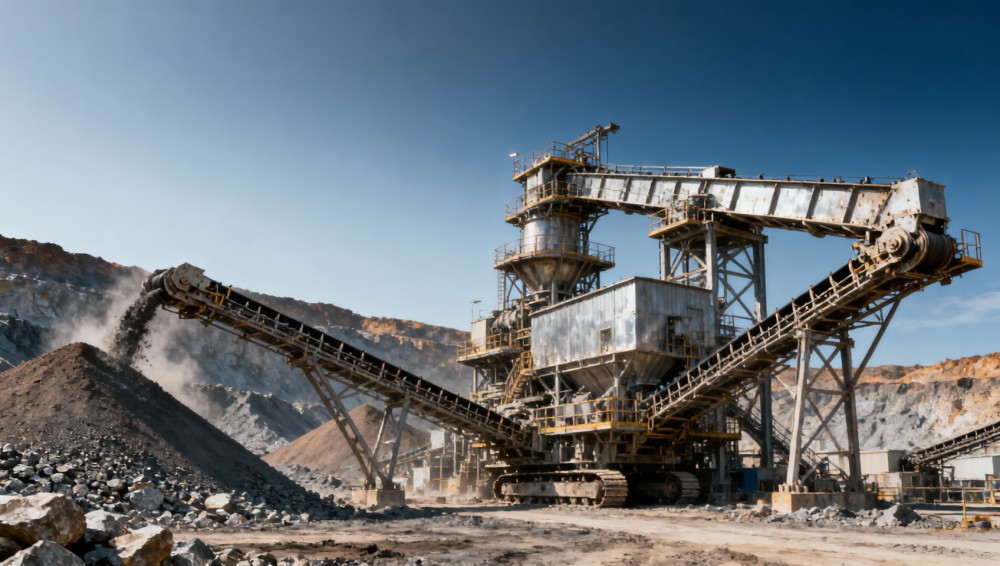
In many mining and mineral processing environments, falling average ore grades are forcing plants to move more material to produce the same output. When feed quality becomes less consistent, screening, crushing, grinding, and separation systems face higher loads and tighter control requirements. A plant that previously handled a stable feed band may now need to manage wider fluctuations, sometimes within a 5% to 15% variability range over a single production cycle.
This shift affects not only miners but also suppliers of industrial equipment, electrical systems, motors, conveyors, pumps, drives, liners, valves, sensors, and process control solutions. Lower-grade ore often means more comminution time, higher wear, and greater energy intensity per ton of finished output. For heavy machinery buyers, the key question is no longer only rated capacity. It is whether the system can sustain acceptable efficiency when feed hardness, moisture, or impurity levels move outside the original design window.
Operational consequences for users and plant managers
For operators, the first visible effect is usually throughput instability. If ore grade declines while gangue content rises, crushing and separation circuits may need more frequent adjustments. This can increase liner replacement frequency from every 10 to 12 weeks to every 6 to 8 weeks in demanding applications, depending on feed abrasiveness and run time. Downtime then becomes a cost multiplier rather than a simple maintenance event.
Energy is the second pressure point. When lower-grade material requires more grinding or additional beneficiation steps, the total electricity demand per usable ton rises. That directly links mining market updates to electrical equipment and supply-chain planning. Variable frequency drives, high-efficiency motors, power quality monitoring, and predictive maintenance sensors are becoming more important in procurement decisions because a few percentage points of efficiency gain can offset part of the grade-related cost burden.
Key adjustment areas
- Reassess crushing and grinding configuration against current feed variability, not last year’s average ore profile.
- Track wear-part life in operating hours and tons processed to detect hidden cost escalation.
- Review power system loading, especially where motors above 75 kW run under unstable material conditions.
- Add real-time sensing for moisture, vibration, and temperature to reduce unplanned shutdown risk.
The table below outlines how ore grade pressure typically translates into equipment-side impacts and practical response priorities for industrial buyers and plant teams.
The key takeaway is that ore grade pressure changes the economics of equipment selection. Buyers who compare only upfront machine price may miss larger cost drivers such as energy intensity, spare-parts turnover, and maintenance labor hours. In current mining market conditions, process resilience is often more valuable than nominal peak capacity.
Input Cost Inflation and Its Effect on Procurement Strategy
Rising mining costs are being pushed by multiple inputs at the same time: fuel, electricity, explosives, grinding media, chemicals, freight, spare parts, and labor. This broad-based inflation is especially important for industrial procurement teams because it affects both direct operating cost and capital project timing. In many cases, suppliers are shortening quotation validity from 60 days to 15 or 30 days, reflecting uncertainty in metals, logistics, and energy markets.
The impact extends beyond mines themselves. Steel industry news, bauxite export developments, and refining industry news all feed into machinery and components demand. If smelters, refiners, and mills adjust output plans, purchasing patterns for motors, drives, castings, filtration units, and material handling systems can change quickly. That means procurement teams need a broader market view rather than relying only on internal historical consumption.
What buyers should evaluate before issuing RFQs
A strong sourcing process now requires at least four layers of review: total landed cost, supply continuity, technical fit under changing ore conditions, and after-sales support response time. For critical components, a 7 to 10 day delivery advantage can outweigh a 3% nominal price difference if the item is tied to plant uptime. Buyers should also separate fast-moving wear parts from strategic equipment packages, because the risk profile is different.
Procurement teams should also examine price-adjustment clauses carefully. When markets are volatile, some suppliers pass through raw-material or freight changes after order confirmation. Others can hold price but extend lead time from 8 weeks to 14 weeks. Neither option is automatically better. The right choice depends on shutdown windows, inventory policy, and the cost of delayed production.
Recommended procurement checklist
- Confirm technical tolerance bands, including feed size, hardness variation, and operating temperature range.
- Ask for lead-time breakdown by manufacturing, inspection, packaging, and transport stage.
- Map critical spare parts by 3-month, 6-month, and 12-month consumption patterns.
- Compare warranty response and field-service availability within 24 to 72 hours where uptime is essential.
The following comparison table helps buyers align sourcing decisions with current mining market updates and cost pressures.
In a rising-cost environment, disciplined procurement is not about slowing down decisions. It is about building better decision criteria. Buyers who structure RFQs around operating risk, maintenance intervals, and supply continuity usually make more resilient choices than those who compare quotes line by line without plant context.
Supply Chain Efficiency: From Export Shifts to Plant-Level Delivery Reliability
Mining market updates increasingly reflect logistics realities. Iron ore flows, bauxite exports, port congestion, inland trucking constraints, customs processing, and container availability can all affect industrial lead times. For users of machinery, electrical equipment, and replacement parts, supply chain efficiency is no longer a back-office metric. It directly affects shutdown planning, plant utilization, and cash-flow discipline.
Export trade developments matter because mineral flows influence vessel allocation and freight costs across adjacent sectors. When shipping capacity tightens, lead time for industrial components may stretch by 2 to 4 weeks even if factory production remains unchanged. This is why many buyers are now splitting orders between standard stock items and engineered items, rather than combining everything into one purchase schedule.
Where supply chain losses usually occur
In many projects, delay risk is concentrated in only a few stages: incomplete technical confirmation, late drawing approval, slow export documentation, and weak spare-parts forecasting. A buyer may negotiate aggressively on unit price, but if document turnaround adds 10 days and customs correction adds another 5 days, the cost of waiting can exceed the original discount. For critical rotating equipment or control components, documentation accuracy is often as important as manufacturing speed.
Supply chain intelligence should therefore include both macro and micro signals. At the macro level, teams should monitor mineral price trends, shipping conditions, and policy interpretation affecting trade routes. At the micro level, they should track supplier on-time delivery, quality deviation rate, and spare-parts fill rate. A practical target for strategic suppliers is often above 95% document accuracy and above 90% on-time shipment performance for repeat orders.
Actions that improve delivery reliability
- Freeze technical specifications earlier for long-lead motors, drives, cast parts, and process equipment.
- Use separate planning tracks for standard consumables and customized assemblies.
- Maintain a minimum stock policy for high-failure or long-import-cycle items, often equal to 1 to 2 maintenance cycles.
- Review incoterms, packaging method, and inspection timing before order release, not after shipment notice.
The practical lesson is simple: procurement efficiency is now inseparable from supply chain design. Companies that treat logistics, documentation, and aftermarket support as part of equipment selection are better positioned to manage mining market volatility without compromising plant continuity.
Why Smart Manufacturing and Automation Are Gaining Priority
As ore quality pressure and input costs rise, smart manufacturing trends are becoming more relevant to mining-related industries and heavy industrial users. Automation is no longer limited to large greenfield projects. Mid-sized plants are also investing in condition monitoring, remote diagnostics, intelligent drives, automated sampling, and production analytics to reduce variability. The reason is straightforward: when margins tighten, even a 2% to 5% improvement in availability or energy efficiency becomes meaningful.
For equipment operators, digital visibility reduces reaction time. Vibration monitoring can identify bearing or alignment issues before failure. Motor current trends can reveal overload conditions tied to changing ore hardness. Conveyor monitoring can detect slippage or abnormal loading. These systems do not remove the need for skilled maintenance teams, but they improve prioritization by turning hidden wear into measurable indicators.
High-value automation areas for current market conditions
The most cost-effective upgrades are usually not the most complex ones. In many facilities, the first return comes from integrating sensors, drives, and dashboards around bottleneck assets. Examples include crushers, mills, pumps, compressors, filtration systems, and conveying lines. Plants can often start with a 3-step rollout: monitor, analyze, then automate control responses. This staged approach lowers implementation risk and spreads capex over 6 to 12 months.
Automation decisions should be linked to specific operating pain points rather than broad digitization goals. If a site suffers frequent screen blockage, moisture and feed monitoring may matter more than an enterprise-wide platform. If power costs are rising, load-balancing and drive optimization may bring faster savings than a full MES deployment. The right architecture depends on process bottlenecks, maintenance maturity, and available technical support.
A practical upgrade roadmap
- Identify the top 5 cost-loss points, such as unplanned stoppage, high energy use, or excessive wear-part replacement.
- Select measurable indicators including vibration, amperage, pressure, temperature, and throughput.
- Pilot on one line or one equipment cluster for 8 to 12 weeks before broader rollout.
- Tie vendor KPIs to uptime, response time, and reporting accuracy, not just hardware delivery.
For buyers and executives, the main evaluation standard should be operational payback. A compact automation package that stabilizes one critical line may outperform a larger but poorly scoped digital project. In today’s mining market, intelligent control is most valuable when it reduces cost volatility and improves maintenance planning.
FAQ: Procurement, Lead Time, and Risk Control Under Current Mining Market Conditions
How should buyers evaluate equipment when ore grades are declining?
Start with operating conditions rather than brochure capacity. Buyers should check whether the equipment can maintain stable performance across expected feed variability, moisture changes, and abrasive conditions. At minimum, compare 4 dimensions: throughput range, energy use, wear-part life, and maintenance access. For critical systems, ask suppliers to explain expected performance under off-design conditions, not only ideal feed assumptions.
What lead time should companies plan for industrial equipment and spare parts?
There is no single rule, but many standard industrial components may fall within 2 to 8 weeks, while customized process equipment, castings, or large motors can require 10 to 20 weeks depending on factory load and shipping conditions. Buyers should request a stage-by-stage timeline covering production, inspection, export paperwork, and transit. For shutdown-critical items, safety stock should often cover at least one maintenance cycle.
Which mistakes are most common in mining-related procurement?
Three mistakes appear often. First, focusing only on purchase price and ignoring downtime cost. Second, approving technical specifications without enough review of actual material conditions. Third, underestimating documentation and logistics risk for imported goods. A sound process combines technical validation, total cost comparison, and delivery-risk mapping before the PO is issued.
When does automation deliver the fastest return?
The fastest return usually comes from bottleneck assets where failure or instability has a visible production impact. In many plants, this includes crushing circuits, pumps, conveyors, and grinding systems. If sensor data helps prevent even 1 major stoppage per quarter, the payback can be more attractive than expected. The best candidates are assets with high run hours, high maintenance burden, and measurable performance loss.
Mining market updates now signal more than commodity movement. They highlight a deeper shift in how ore quality, cost inflation, logistics performance, and automation investment interact across manufacturing, processing machinery, industrial components, and electrical equipment supply chains. For operators, the priority is process stability. For procurement teams, it is total cost and delivery reliability. For business leaders, it is making practical investments that protect output and flexibility.
Companies that respond early with better specification control, smarter sourcing frameworks, and targeted efficiency upgrades are more likely to manage volatility without losing competitiveness. If you need tailored market insight, sourcing support, or solution guidance related to mining-linked industrial equipment and supply chain decisions, contact us now to discuss your project, request a customized plan, or explore more industry solutions.


Industry Briefing
Get the top 5 industry headlines delivered to your inbox every morning.