
How to assess whether industrial equipment retrofits extend service life
How to Assess Whether Industrial Equipment Retrofits Extend Service Life
Industrial equipment retrofits are often presented as a practical middle path between routine maintenance and full replacement. That can be true. Replacing an obsolete drive, upgrading a control platform, rebuilding a hydraulic unit, or adding condition monitoring may keep a production asset useful for years longer. But a retrofit does not automatically extend service life simply because the machine runs again after commissioning.
The real question is whether the upgrade removes the limits that would otherwise force retirement. For technical evaluators, that means looking beyond the proposed component list. A modern PLC cannot correct fatigue damage in a machine frame. A new motor may reduce energy losses, but it can also expose a weak gearbox, undersized cable system, or inadequate cooling arrangement. In some cases, a retrofit improves availability without materially extending the equipment’s safe operating life. Those are different outcomes and should be assessed separately.
A sound decision combines mechanical condition, electrical integrity, control-system viability, safety obligations, process requirements, supplier support, and the economics of downtime. The point is not to prove that every old asset deserves modernization. It is to identify which industrial equipment retrofits preserve a fundamentally sound asset and which merely postpone an inevitable replacement decision.
Start with the failure mechanism, not the upgrade proposal
Many retrofit projects begin with a visible problem: repeated inverter faults, unavailable spare parts, slow cycle times, poor positioning accuracy, or an operator interface that is no longer serviceable. These are legitimate triggers, but they are symptoms. Before selecting a retrofit scope, the technical team should establish why the equipment is underperforming and whether that cause sits inside or outside the proposed upgrade boundary.
For example, an aging packaging line may suffer frequent stoppages attributed to obsolete controls. A control-system upgrade could be justified if diagnostic limitations, unstable I/O hardware, and unsupported software are the main sources of lost production. It is less convincing if the real issue is wear in cam mechanisms, inconsistent pneumatic supply, or product variation that the original mechanical design cannot accommodate. In that situation, new controls may make faults easier to see, but not less frequent.
Maintenance history is usually the best starting point. Review work orders, alarm records, breakdown reports, spare-parts consumption, and operator observations over a meaningful period. Look for patterns rather than isolated events. Failures concentrated in one obsolete subsystem may support a targeted modernization. Failures spread across structures, bearings, transmissions, hoses, sensors, and electrical enclosures often indicate broader asset deterioration.
It also helps to separate failure modes into three groups: correctable degradation, design limitations, and unknowns. Correctable degradation includes replaceable wear components, outdated electronics, deteriorated wiring, and inadequate guarding. Design limitations include insufficient load capacity, poor access for maintenance, constrained throughput, or an original architecture that cannot meet current quality requirements. Unknowns deserve caution. If internal corrosion, concealed cracking, undocumented modifications, or incomplete drawings are involved, the inspection scope may need to expand before a business case is approved.
Determine whether the base machine still has structural life
A retrofit only has a credible life-extension case when the base equipment remains mechanically and structurally fit for its intended duty. This is particularly important for presses, lifting equipment, mixers, rotating machinery, process skids, furnaces, large pumps, conveyors, and high-cycle automated systems. New electrical hardware can create the impression of renewal while leaving the most consequential risks untouched.
The assessment should consider load-bearing frames, foundations, shafts, gear sets, pressure-containing parts, welds, bearings, guides, couplings, and alignment. The appropriate inspection method depends on the asset and its failure risks. Visual examination, vibration analysis, oil analysis, thermography, dimensional checks, alignment verification, and non-destructive testing may all be relevant, but none should be used as a ritual. The methods should be selected because they answer a specific question about remaining condition.
Duty history matters as much as age. Two machines installed in the same year may have very different remaining life if one has operated within its original load profile and the other has been repeatedly pushed through higher loads, faster cycles, harsher temperatures, or more abrasive materials. A machine that appears lightly used can still be compromised by poor lubrication, long idle periods in a corrosive environment, or repeated starts and stops.
One practical test is to ask whether the retrofit will increase stress on the old machine. Faster servo motion, higher motor torque, more aggressive acceleration, increased throughput, or heavier product handling can move the asset beyond assumptions embedded in its original design. If a proposed upgrade changes duty cycle, speed, load, temperature, pressure, or operating envelope, the mechanical review cannot be treated as a side task.
Assess the retrofit as a system, not a collection of replacement parts
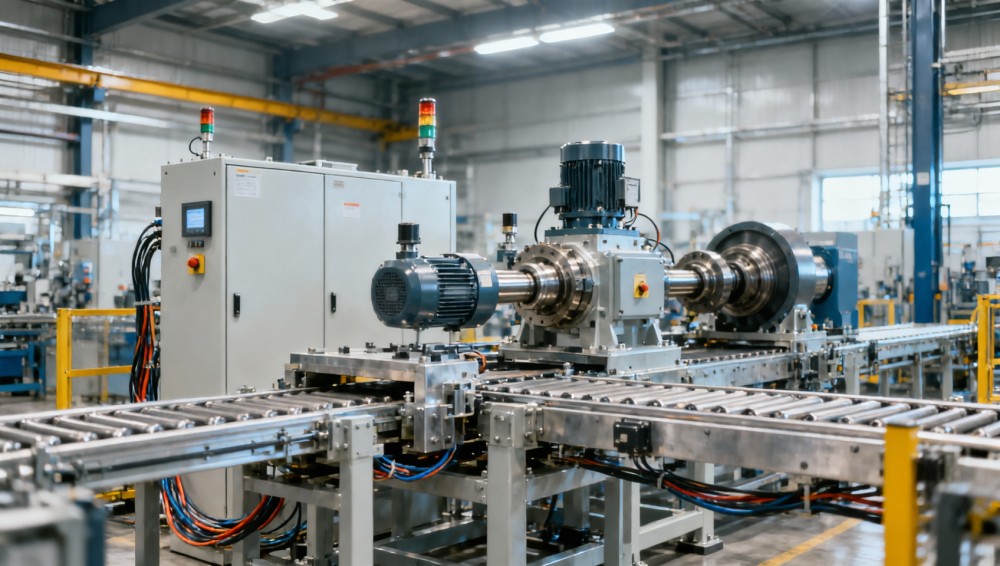
The weak point in many industrial equipment retrofits is integration. Replacing a legacy PLC, variable-frequency drive, motor, HMI, power supply, or sensor network may seem straightforward on a bill of materials. In service, however, the upgrade has to operate with existing motors, field devices, panels, interlocks, communication networks, mechanical actuators, and plant-level systems.
Technical evaluators should insist on an interface map before committing to the project. It should identify physical interfaces, electrical ratings, signal types, communication protocols, safety circuits, process dependencies, software ownership, and required operating modes. If the machine has been modified over time, original drawings may no longer reflect reality. A field survey and point-to-point verification can prevent expensive surprises during shutdown.
Electrical compatibility deserves more attention than it sometimes receives. A new drive may require consideration of motor insulation condition, cable length, reflected-wave effects, grounding, electromagnetic compatibility, harmonic impact, and cooling at low speed. Similarly, installing higher-performance controls in an old cabinet may reveal that enclosure ventilation, short-circuit protection, or segregation of power and signal wiring is no longer adequate. These are not minor commissioning details; they affect reliability over the next operating period.
Treat safety changes as part of the scope
A retrofit can change the risk profile of equipment even where the production process looks familiar. Higher speeds, automatic restart logic, remote diagnostics, new motion axes, altered access points, or revised control sequences can introduce hazards that were not present in the legacy configuration. The team should determine which machinery-safety requirements, electrical safety practices, and local obligations apply to the specific installation rather than assuming that an upgrade inherits the old machine’s status.
The most useful question is not “Does the supplier provide safety hardware?” It is “What risks remain after this modification, and how will they be validated?” Guarding, emergency stops, safety-rated control functions, lockout arrangements, safe maintenance access, and operator training should be considered alongside performance goals. A retrofit that cannot be safely handed over, maintained, and troubleshot is not a durable extension of asset life.
Compare the likely service horizon with the cost of disruption
The financial case should not be reduced to retrofit price versus replacement price. Technical teams need to estimate the remaining useful horizon after modernization, the probability of residual failures, planned shutdown duration, production losses during installation, availability of spares, and the cost of maintaining two generations of technology. A lower initial scope can be false economy if it leaves a critical old subsystem that will require another major outage soon after commissioning.
It is often helpful to compare three choices: targeted repair, full retrofit, and replacement. Targeted repair is suitable when the asset is otherwise sound and the problem is genuinely isolated. Full retrofit makes sense when several obsolescence or reliability issues can be addressed during one controlled shutdown. Replacement becomes more persuasive when the structural base is near its limit, process requirements have moved beyond original capability, or the retrofit would involve extensive custom engineering with no clear support path.
Do not let a long list of new parts create confidence by itself. What matters is the residual risk register after the project. It should state what remains old, what cannot be inspected without further dismantling, what components have uncertain lead times, and which future upgrades may still be necessary. An honest residual-risk view is usually more valuable than a highly optimistic payback calculation.
Check maintainability after handover
A modernization project should leave the plant easier to support than before. That means current drawings, electrical schematics, software backups, version records, parameter lists, spare-parts recommendations, test records, and clear ownership of passwords and source code. Without these basics, a newly retrofitted machine can become another difficult legacy asset surprisingly quickly.
The supplier ecosystem also matters. Evaluators should verify whether proposed components are widely supported in the relevant market, whether local or regional technical service is realistic, and whether alternative sourcing routes exist for non-proprietary items. This is especially relevant for exporters, EPC contractors, and multi-site manufacturers working across different voltage systems, control standards, and service environments.
Before final acceptance, define measurable operating checks that reflect the reason for the retrofit: stable cycle performance, repeatability, alarm response, safety-function verification, temperature behavior, vibration trends, or recovery after a power interruption. The acceptance plan should test normal production, not just an unloaded demonstration.
Make the decision with evidence that can survive scrutiny
The strongest retrofit decisions are built around a simple conclusion: the base asset has enough remaining mechanical and structural integrity, the modernization addresses identified failure mechanisms, the revised system can be operated safely, and the remaining risks are acceptable for the expected service horizon. If one of those statements cannot be supported, the project needs a narrower claim or a different solution.
For organizations monitoring equipment markets and sourcing options, information from component suppliers, machinery specialists, automation vendors, and industrial supply-chain channels can help clarify what is technically supportable. Platforms such as NEXUSINSIGHTS are useful for tracking technology upgrades, supplier developments, industrial equipment trends, and cross-border sourcing conditions—but market visibility should support, not replace, site-level engineering evidence.
A retrofit extends service life when it restores confidence in the asset’s future operation. If it only makes an old machine appear newer while leaving its dominant failure risks in place, it is better understood as a temporary repair strategy. That distinction should be clear before shutdown dates, budgets, and production commitments are approved.
Industry Briefing
Get the top 5 industry headlines delivered to your inbox every morning.