
How to Select Portable Maintenance Equipment for Remote Industrial Sites

How to Select Portable Maintenance Equipment for Remote Industrial Sites
Remote industrial sites rarely fail in convenient ways. A pump coupling begins to loosen at a mining camp, a corroded cable termination needs attention at a wind installation, or a hydraulic fitting fails at a temporary construction yard hours away from the nearest workshop. In these situations, maintenance capability is not defined by the size of the central tool room. It is defined by what can be transported safely to the asset, operated reliably in field conditions, and repaired or replaced without creating a second logistics problem.
For project managers, selecting portable maintenance equipment is therefore a planning decision rather than a simple purchasing exercise. The right combination can shorten response time and reduce avoidable equipment downtime. The wrong combination can leave technicians carrying heavy tools with inadequate power, incompatible consumables, or no practical way to service the equipment after the first breakdown.
A useful starting point is to define the field work that must be completed, not the broad category of tools the site “might need.” Portable equipment for emergency electrical repair, rotating-equipment alignment, structural fastening, hose repair, welding, lubrication, or inspection has different demands. A kit designed for daily maintenance on a paved utility site will not necessarily survive a seasonal road, a marine environment, or an unmanned installation with limited lifting access.
Begin with the repair profile, not the catalogue
Before comparing brands or power ratings, map the maintenance tasks that are likely to occur during normal operation and during credible fault scenarios. This is where many procurement lists become too generic. “Portable power tools” says very little. A field team may actually need a torque-controlled fastening solution, compact cutting equipment, electrical test instruments, a portable grease system, battery-powered lighting, and a way to lift or position components safely. Each has a different failure consequence if it is unavailable.
It helps to separate work into three groups: routine preventive work, corrective repairs that can wait for scheduled access, and failures that require immediate intervention. Routine tasks often justify lighter, standardized kits. Emergency repairs may require redundancy, specialist tooling, spare batteries, or equipment that is less compact but more capable. A portable hydraulic torque wrench, for example, may be justified where bolted joints are safety-critical or difficult to access, but it is excessive if most field work consists of enclosure checks and minor adjustments.
Ask the maintenance lead a practical question: what repair is most likely to stop production, and what must a technician physically bring to complete it in one visit? The answer often exposes missing items such as cable preparation tools, correct sockets, charging leads, test leads, extraction equipment, or consumables. A cordless grinder without suitable discs, a pump without hose adapters, or a torque tool without the required reaction arrangement is not a field-ready solution.
Mobility is more than low weight
Weight matters, but portability is really a transport-system question. Equipment may travel by pickup, service vessel, helicopter, rail vehicle, all-terrain vehicle, or on the back of a technician walking over uneven ground. The selected tool must fit the access route as well as the repair task.
A compact unit can still be difficult to deploy if it requires multiple cases, loose cables, a separate generator, and two people to move it safely. Conversely, a heavier machine may be the better choice when it can remain on a service vehicle and eliminates repeat trips. Project teams should look at packed weight, case dimensions, handle placement, wheel design, lifting points, and whether the equipment can be secured during transport. In offshore, elevated, or confined work areas, the ability to hoist a kit safely may matter more than its nominal mass.
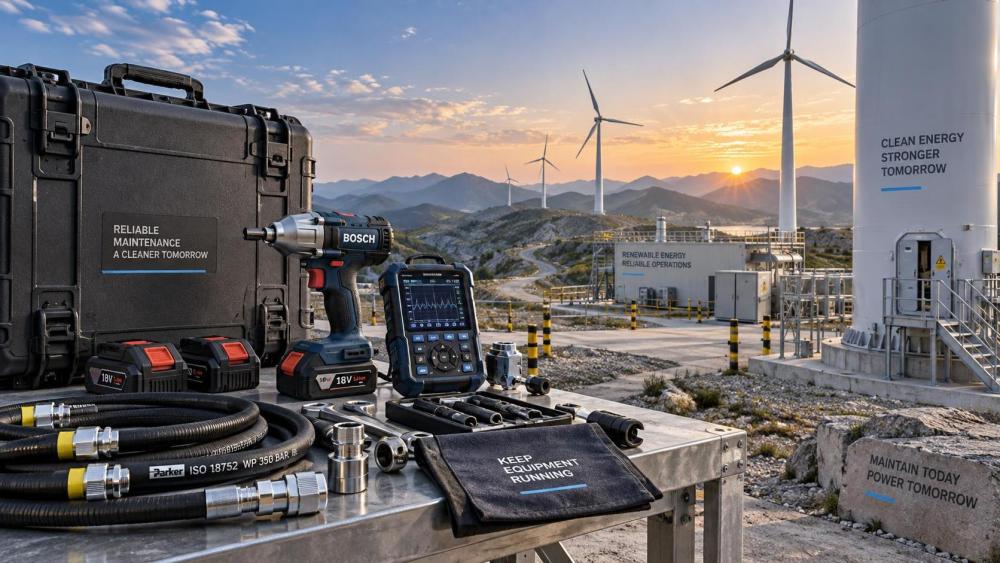
Cases deserve more scrutiny than they usually receive. Field equipment is commonly damaged during loading, unloading, and storage rather than during operation. A robust case should protect instruments and vulnerable accessories, keep the kit organized, and make missing parts obvious. For remote crews, foam inserts or labeled compartments are useful only if they still accommodate replacements and site-specific accessories. Overly customized packing can become a nuisance once the original layout no longer matches the equipment in service.
There is also a human-factor limit. If a technician cannot reasonably carry, position, connect, and operate a tool under site conditions, its performance on paper is irrelevant. Review the deployment sequence, including opening the case, putting on required protective equipment, connecting power, carrying out the work, and packing down. This simple walk-through often reveals awkward equipment choices before they reach site.
Choose the power architecture early
Power availability is one of the most consequential selection criteria for portable maintenance equipment. Remote sites may have stable grid power, temporary generators, vehicle-mounted inverters, renewable power systems, or no dependable source at all. The tool choice should follow the site’s real power conditions, not an assumption that an extension lead will be available.
Battery-powered equipment has transformed field maintenance because it reduces cable management and can be deployed quickly. It is particularly useful for intermittent tasks, access-constrained locations, and areas where running leads would create a trip or entanglement hazard. The trade-off is battery management. A tool platform is only as reliable as its charging plan, the availability of spare packs, battery storage conditions, and the ability to obtain replacements over the project life.
For sustained cutting, pumping, heating, welding, or high-torque work, corded electric, hydraulic, pneumatic, or engine-driven equipment may still be more appropriate. Each introduces dependencies. Pneumatic tools require clean and sufficient compressed air. Hydraulic systems require hoses, couplings, fluid discipline, and leak control. Combustion-powered units may create ventilation, fuel-handling, noise, or emissions constraints. Electrical equipment requires confirmation of voltage, frequency, plug type, grounding arrangements, and protection suitable for the environment.
Do not treat the power source as an accessory. Specify it as part of the maintenance package. A portable generator, charger, battery inventory, adapters, distribution equipment, and safe storage arrangement may be just as important as the primary tool. Where the site has hazardous-area requirements, electrical classification and local operating rules need specialist review; a standard portable unit should never be assumed suitable merely because it is rugged.
Durability must match the actual exposure
“Industrial grade” is too vague to guide a purchase. A remote desert site, a tropical processing plant, a coastal terminal, and a cold-weather pipeline installation place very different stresses on equipment. Dust, salt spray, humidity, vibration, mud, ultraviolet exposure, temperature swings, and aggressive cleaning methods can all shorten service life.
Review enclosure protection, corrosion resistance, cable flexibility, connector quality, switch design, and the vulnerability of displays or control panels. For inspection instruments, the question is not only whether the housing can resist impact, but whether the readings remain dependable after repeated transport and exposure. For powered tools, inspect the practical weak points: battery latches, hose fittings, trigger assemblies, charging contacts, cooling vents, and cable strain relief.
A frequent mistake is buying the most heavily protected option for every task. Extra protection can add weight, cost, and maintenance complexity. The better approach is to identify the equipment that will be exposed continuously and specify more robust protection there, while keeping occasional-use tools practical and serviceable. Equipment stored inside a sheltered service container faces a different risk profile from tools carried daily to open work fronts.
Compatibility prevents expensive field improvisation
Portable tools work within systems. Their usefulness depends on sockets, blades, test probes, chargers, hydraulic couplers, abrasives, drill bits, fasteners, hose sizes, software interfaces, and calibration arrangements. A technically capable item becomes a liability when it introduces a unique battery format, proprietary connector, or consumable that cannot be sourced through the project’s established supply chain.
Standardization has genuine operational value. Where possible, align cordless tools on a limited number of battery platforms, align fastener tools with common drive sizes, and align electrical test equipment with the site’s inspection procedures. That does not mean forcing every tool into one ecosystem. Specialist equipment may need its own platform. It does mean being deliberate about exceptions and ensuring they come with a clear replenishment plan.
For engineering projects with multiple contractors, compatibility should also be discussed before mobilization. Contractors often arrive with familiar tools, while the owner or EPC team has site-specific safety, charging, isolation, and inspection rules. A short equipment interface review can prevent confusion around adapters, voltage connections, lifting accessories, and responsibility for calibration or repairs.
Look beyond acquisition price
The least expensive purchase price can be misleading at a remote site. The relevant cost includes transport, storage, spare parts, calibration where applicable, battery renewal, consumables, repairs, downtime exposure, and the labor required to keep the kit ready. A lower-cost tool with no local repair path may be more expensive than a higher-priced alternative supported by a distributor near the project route.
Lead time is especially important. Ask which parts are normally stocked, which components are repairable, and whether the supplier can provide technical documentation in a form the maintenance team can use. For critical tools, consider whether a spare unit is more sensible than waiting for a repair. This is not always necessary, but it deserves attention for equipment that has a single point of failure in the maintenance plan.
Information platforms such as NEXUSINSIGHTS can help project teams monitor supplier activity, equipment developments, industrial market movements, and changes across global supply chains. That market visibility is useful when comparing sourcing options, particularly for projects exposed to long delivery routes or multiple regional suppliers. It should complement, rather than replace, a technical review of the specific equipment and its support arrangement.
Make safety part of the selection decision
Field maintenance is often performed under time pressure, in poor weather, or close to operating assets. Equipment that is safe in a controlled workshop may be awkward or risky in a remote location. Consider grip and balance, emergency stops, guarding, lighting, noise, vibration, heat generation, hose routing, battery handling, and the likelihood of accidental activation during transport.
The equipment should also fit the site’s wider control measures. Isolation procedures, work permits, lifting plans, confined-space rules, electrical safety requirements, and hot-work restrictions may limit what can be used. A portable welding package, for instance, cannot be evaluated solely on output; the project must also consider fire controls, gas handling, ventilation, consumable storage, and the competence required to use it.
Training requirements should be visible in the selection record. Complex equipment may be justified, but only if the intended users can maintain competence and the site can retain operating instructions. A tool that needs a specialist operator is not truly portable from an operational standpoint if that person is not available when the failure occurs.
A practical evaluation before committing
When the equipment is important to project continuity, test the proposed solution against a representative task. The test does not need to be elaborate. Confirm that the team can transport it through the likely access route, connect it to the intended power source, use the required accessories, complete a normal work sequence, and return it to a ready state. Include the technician who will use it, not only procurement and engineering staff.
The best portable maintenance equipment is rarely the model with the longest feature list. It is the equipment that fits the repair profile, reaches the asset without excessive effort, works with the site’s power and safety conditions, and can be kept operational through the realities of remote supply and service. If those questions are answered before purchase, the maintenance kit becomes a workable field capability rather than a collection of tools waiting in cases.

Industry Briefing
Get the top 5 industry headlines delivered to your inbox every morning.