
Hazardous Waste Equipment News: 2026 Compliance Risks and Upgrades


In 2026, hazardous waste compliance is moving from periodic review to continuous proof. That shift makes environmental equipment news for hazardous waste a practical operating signal, not just a media topic.
Across manufacturing, industrial equipment, and electrical supply chains, treatment, storage, labeling, ventilation, and digital logging systems now affect audit outcomes, shipment continuity, and site safety.
Facilities that track environmental equipment news for hazardous waste early can rank risks, schedule upgrades, and avoid last-minute spending after inspections or customer compliance reviews.
When 2026 compliance pressure hits different operating scenarios
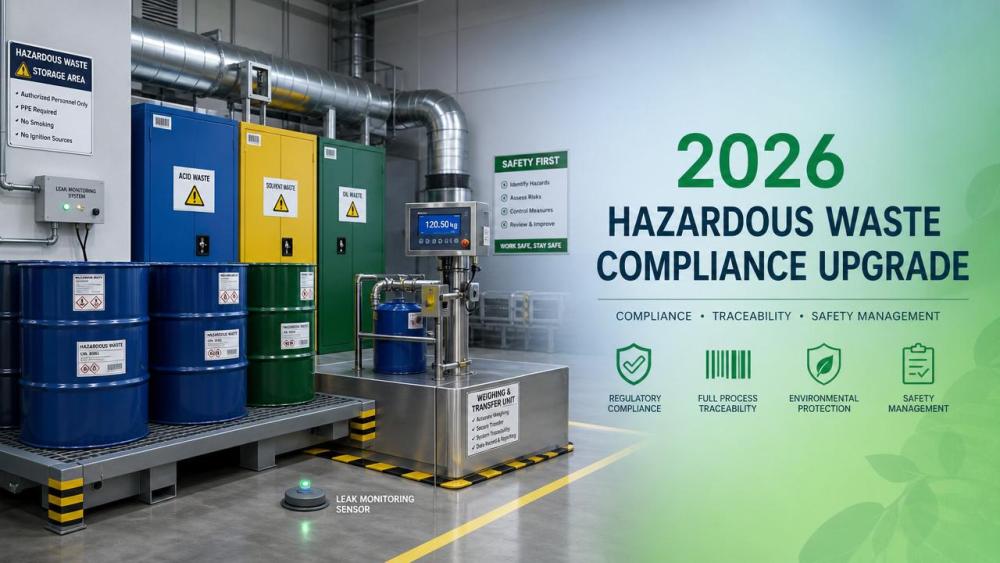
Not every site faces the same exposure. A plating line, battery assembly plant, chemical blending workshop, and parts cleaning station generate very different hazardous waste profiles.
That matters because environmental equipment news for hazardous waste often highlights new monitoring, containment, or documentation demands tied to specific waste streams and storage conditions.
The strongest planning approach starts with scenario judgment. Identify where waste is generated, how long it stays onsite, what records are needed, and which equipment creates the highest compliance risk.
Scenario 1: High-volume production with frequent waste transfer
High-throughput plants often move drums, totes, and sludge containers daily. Here, the main risk is process speed outrunning labeling, weighing, sealing, and manifest accuracy.
Environmental equipment news for hazardous waste increasingly points to automated weighing, barcode tracking, leak detection, and transfer-area ventilation as priority upgrades.
Scenario 2: Multi-waste facilities with mixed chemical compatibility
Sites generating solvents, heavy metal residues, oily absorbents, acidic liquids, and contaminated packaging face segregation risk more than pure volume risk.
In this scenario, storage cabinet design, secondary containment, sensor placement, and compatibility mapping become more important than simple capacity expansion.
Scenario 3: Export-linked operations under customer audit pressure
Export supply chains now examine environmental records alongside product quality records. A weak hazardous waste setup can delay qualification, shipment approval, or contract renewal.
For these sites, environmental equipment news for hazardous waste should be read through the lens of traceability, data retention, and visible control measures.
Which application settings need upgrades first
Upgrade decisions should not begin with a catalog. They should begin with the operating setting where a single failure can create a reportable event or repeated audit finding.
The following application settings deserve early review when reading environmental equipment news for hazardous waste in 2026.
Waste collection points near active production lines
Open handling, wrong container selection, and temporary overfill are common issues here. Compact transfer systems and clearer status indication reduce operator error.
If line speed increased during recent capacity expansion, collection hardware may now be undersized even when records still show nominal compliance.
Temporary storage rooms with aging infrastructure
Many facilities still rely on older floors, basic spill pallets, and manual inspections. In 2026, that setup may fail to support faster reporting expectations.
Environmental equipment news for hazardous waste often signals movement toward continuous sensing, access logs, temperature records, and remote alarm functions.
Treatment support areas and pre-disposal staging
Mixing, dewatering, neutralization, or consolidation steps create complex liability because the waste condition changes before final handoff.
These zones benefit from better flow control, sealed interfaces, vapor capture, and calibrated measurement tools that support accurate waste classification.
How needs differ across hazardous waste operating scenarios
A comparison table helps convert environmental equipment news for hazardous waste into site-specific action instead of generic concern.
This type of comparison keeps investment disciplined. It also helps explain why environmental equipment news for hazardous waste affects some facilities sooner than others.
Practical upgrade paths based on site conditions
A useful upgrade path balances compliance urgency, process impact, and capital timing. The best results usually come from phased improvements, not one large replacement cycle.
- Start with containers, seals, labels, and spill control where failures are most visible.
- Add sensing for leaks, temperature, vapor, or fill level in storage and transfer zones.
- Connect weighing, scanning, and manifest data to reduce manual transcription errors.
- Upgrade ventilation and isolation where waste handling occurs near sensitive production.
- Review floor coating, drainage control, and emergency response hardware together.
When following environmental equipment news for hazardous waste, give priority to upgrades that improve both containment and evidence. Regulators increasingly expect proof, not just procedures.
Low-disruption upgrades for operating plants
Many sites avoid upgrades because shutdown windows are limited. In such cases, modular sensing, portable containment, and digital record tools often provide the fastest risk reduction.
This is especially relevant in industrial equipment and electrical component production, where layout changes can interrupt validated workflows.
Higher-impact upgrades for recurring audit findings
If the same issue appears in inspections, deeper changes are needed. Examples include storage room redesign, closed transfer systems, and integrated monitoring dashboards.
Environmental equipment news for hazardous waste often reveals which technologies are becoming baseline expectations rather than optional improvements.
Common misjudgments that increase 2026 compliance risk
Several mistakes appear repeatedly across sites, even where formal procedures exist. These misjudgments usually come from assuming old equipment still matches current risk.
- Treating hazardous waste storage as a housekeeping issue instead of a process control issue.
- Assuming manual logs are acceptable without timestamp integrity or exception tracking.
- Expanding production without rechecking waste generation peaks and container turnover rates.
- Focusing only on disposal vendors while ignoring onsite transfer and staging exposure.
- Buying equipment by capacity alone without checking chemical compatibility and maintenance needs.
Another common mistake is reading environmental equipment news for hazardous waste only after a regulation update becomes urgent. By then, procurement lead times may already be difficult.
Early review supports better budgeting, pilot testing, and supplier comparison, especially where imported components or specialized sensors are involved.
What to do next with environmental equipment news for hazardous waste
Turn information into a site action list within thirty days. That keeps environmental equipment news for hazardous waste connected to measurable operational decisions.
- Map every hazardous waste point from generation to handoff.
- Rank each point by spill risk, traceability risk, and inspection visibility.
- Compare current equipment against 2026 monitoring and documentation expectations.
- Set phased upgrades for immediate, mid-term, and capital-cycle actions.
- Track policy updates, technology releases, and supply chain lead times monthly.
For industry portals covering machinery, industrial components, and electrical equipment, the most valuable environmental equipment news for hazardous waste connects regulation, technology, pricing, and implementation timing.
That perspective helps operations reduce compliance risk before nonconformities affect production, export readiness, or supplier credibility. In 2026, readiness will depend on faster judgment and smarter upgrades.

Industry Briefing
Get the top 5 industry headlines delivered to your inbox every morning.