
Used vs. Refurbished Construction Equipment: Evaluating Lifecycle Cost and Risk


The lower purchase price of a used machine is visible on the quotation. The cost of lost production is not. That distinction is central when comparing used and refurbished construction equipment. A properly refurbished excavator, loader, dozer, crane, or telehandler can justify a higher initial outlay when the refurbishment scope is documented, the remaining service life is credible, and support is available where the machine will work. A poorly defined “refurbished” unit, however, can carry nearly the same hidden risks as an ordinary used asset while being priced at a premium.
The practical choice is therefore not between “cheap used” and “safe refurbished.” It is between two different risk allocations. Used equipment transfers most uncertainty to the buyer. Refurbishment can reduce that uncertainty, but only if it addresses the components and records that determine uptime, safety, compliance, and repairability over the planned ownership period.
Used and refurbished are commercial descriptions, not consistent technical grades
“Used” generally means equipment sold in its current condition, perhaps after cleaning, basic servicing, and a functional check. It may have a known maintenance record, or it may have passed through several owners, dealers, rental fleets, auctions, or export channels with incomplete history. Condition varies sharply even among machines of the same age and operating hours.
“Refurbished” has no single universal definition. One seller may use it for repainting, replacement of wear items, oil changes, and minor repairs. Another may mean an extensive rebuild involving engine work, hydraulic pump testing, undercarriage renewal, electrical repairs, structural inspection, and performance validation. These are not comparable offers, even when the machines share the same model and year.
The first decision is to convert the word “refurbished” into an auditable scope of work. A quotation should state what was inspected, what was measured, what was replaced, which parts were repaired rather than renewed, and what work remains outside the seller’s responsibility. A claim that the machine is “ready to work” is not a technical acceptance standard.
For machines with electronically controlled engines or sophisticated hydraulic systems, the scope should also clarify whether diagnostic faults were scanned and cleared only, or whether the underlying cause was corrected. Cosmetic restoration can conceal leakage, welding repairs, corrosion, loose harnesses, and excessive play in pins or bearings. Paint is not evidence of mechanical condition.
Lifecycle cost begins with the operating requirement, not the asset price
A sound comparison starts with the job the machine must perform. An excavator assigned to intermittent site preparation has a different cost profile from one expected to load trucks on a production schedule every shift. Likewise, a standby generator or rough-terrain crane may have limited annual hours but face a high consequence if it fails at a critical moment.
Lifecycle cost can be considered as:
Acquisition and delivery cost + commissioning cost + planned maintenance + unplanned repairs + downtime impact + compliance and insurance costs − residual value.
Financing, import duties, inland transport, attachments, operator familiarization, and initial spares should be included where relevant. A machine that appears inexpensive at the port can become costly if it needs an undercarriage, tire set, emissions-system repair, boom-line replacement, or major hydraulic work before it can enter service.
Downtime is often the least disciplined element in the calculation. Its value is not merely the repair invoice. It can include idle labor, substitute equipment hire, disrupted haulage or concrete schedules, liquidated damages under a project contract, and reduced ability to redeploy crews. On a low-utilization machine with no hard completion deadline, this exposure may be manageable. On a constrained project, it may outweigh the saving made on purchase price.
Residual value also deserves scrutiny. A well-documented refurbishment performed with recognized parts and supported by maintenance records may preserve resale credibility. A machine with uncertain engine work, nonstandard modifications, or no parts traceability can be difficult to sell later, even if it performs adequately in the short term.
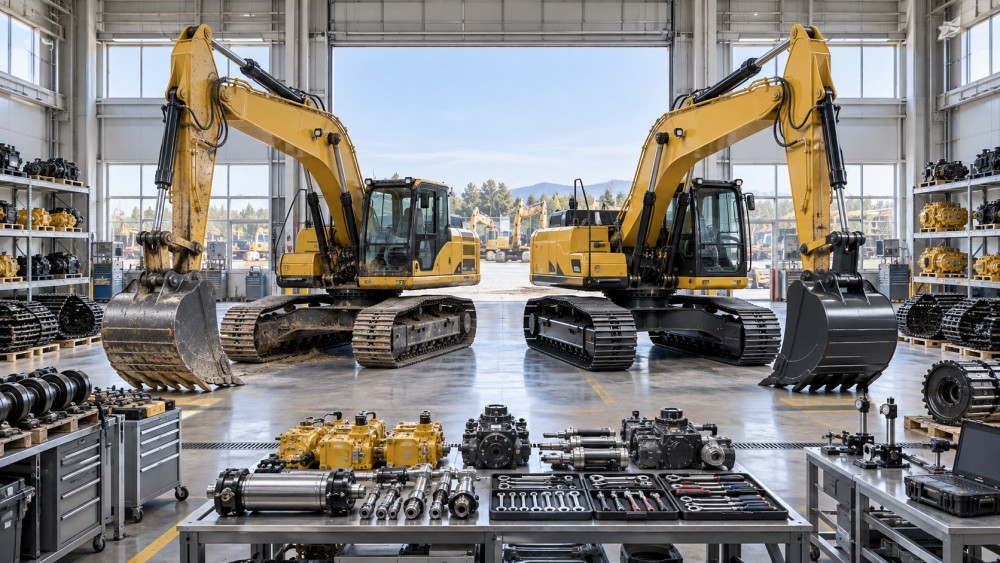
The real condition drivers are not equally expensive to correct
Operating hours are useful, but they are not a condition report. Hour meters can be replaced, repaired, disconnected, or simply interpreted without context. More importantly, equal hours do not mean equal wear. A machine operated in abrasive aggregate, corrosive coastal conditions, extreme heat, demolition, or continuous heavy loading will age differently from the same model used in lighter earthmoving work.
The cost and consequence of deterioration depend on the component group.
- Engine and aftertreatment: Compression condition, blow-by, oil pressure, cooling performance, fuel-system behavior, fault history, and emissions-control status affect both reliability and regulatory suitability. Rebuilding an engine may be economical; resolving poorly diagnosed electronic or aftertreatment issues can be less predictable.
- Hydraulic system: Pump efficiency, cylinder drift, valve response, hose condition, contamination, and hydraulic oil analysis matter more than a brief unloaded function test. Hydraulic contamination can damage several components and create repeat failures after an apparently isolated repair.
- Undercarriage, axles, and driveline: For tracked equipment, rails, rollers, sprockets, idlers, track chains, and shoes represent a significant wear-cost exposure. For wheeled machines, axle play, differential condition, transmission response, tire quality, and brake performance require equal attention.
- Structure and work equipment: Booms, sticks, frames, counterweights, loader arms, crane sections, and attachment interfaces should be checked for cracks, distortion, unauthorized weld repairs, and pin or bushing wear. Structural repairs may affect safe working limits, insurability, and resale acceptance.
- Controls and electrical systems: Sensors, displays, control modules, wiring looms, cameras, safety interlocks, and telematics hardware can be disproportionately difficult to source or diagnose in export markets.
A refurbishment budget should prioritize systems that control safety, productive output, and failure propagation. Replacing seat covers and repainting panels may be appropriate finishing work, but it should not be confused with restoring hydraulic performance or verifying structural integrity.
Maintenance history has value only when it can be connected to the machine
Service records are strongest when they show serial number, date, operating hours, service provider, parts used, and the work performed. A folder of generic invoices or a maintenance checklist without machine identification has limited value. Records should be assessed alongside physical evidence: filter dates, oil-condition results, component labels, dealer service entries, diagnostic reports, and the consistency of wear across controls, pedals, pins, tires, and attachments.
For a refurbished unit, ask for a before-and-after record rather than a final repair list alone. The most useful documentation identifies the incoming condition, measured clearances or test results, corrective action, parts references, and final validation. This makes it possible to distinguish a rebuilt hydraulic cylinder from one that was resealed, or an overhauled engine from one that received routine filters and fluids.
Component provenance matters when major assemblies have been replaced. A remanufactured transmission, engine, swing motor, or hydraulic pump should be identifiable by part number and serial number, with the warranty terms of the component available for review. “New parts installed” is insufficient where substitute brands, salvaged assemblies, or non-OEM equivalents may affect future support.
Warranty language can create false confidence
A warranty is valuable only when its coverage, administration, and enforceability match the project location. A 90-day warranty on a refurbished machine may be meaningful if it covers major components, includes clear claim procedures, allows local inspection, and is backed by a supplier capable of providing parts or reimbursement. It has little operational value if the buyer must return the machine overseas, obtain seller approval before every repair, or prove an undefined manufacturing defect.
Coverage exclusions deserve more attention than the headline warranty period. Wear parts, hoses, seals, electronics, travel motors, hydraulic pumps, transport damage, and labor are frequently treated differently. For equipment exported across borders, establish who pays for diagnosis, freight, customs costs on replacement parts, local labor, and machine immobilization. A warranty that supplies a part but leaves all urgent logistics to the buyer may not protect a time-sensitive project.
It is also important to separate seller warranty from OEM warranty. Refurbishment by an independent workshop does not necessarily preserve manufacturer support. If the machine is still within an original warranty period, unauthorized modifications or non-approved service may affect coverage. This is particularly relevant for late-model equipment with emissions systems, machine-control features, or software-locked functions.
Compliance should be screened before the commercial negotiation is finished
Importability and site eligibility can alter the value of a used machine more than its physical condition. Engine-emissions requirements, registration rules, lifting-equipment inspections, safety guarding, operator-protection structures, noise limits, and local road transport requirements differ by jurisdiction and application. A unit that is mechanically attractive may be unsuitable for import, restricted from certain sites, or costly to modify.
For lifting equipment, records relating to load charts, safety devices, inspection history, and structural condition are especially important. For earthmoving equipment, verify that the configuration does not compromise required rollover or falling-object protection. For machines intended to operate in regulated urban, industrial, or public-sector environments, the engine-emissions category and availability of compliant service support should be verified early.
Serial-number checks should also confirm machine identity, ownership status where available, and whether the configuration matches the documents provided. The risk is not limited to fraud. Incorrect serial references can prevent access to parts catalogs, service bulletins, software support, or accurate build specifications.
A lower-risk evaluation process separates evidence from seller assurance
The used and refurbished construction equipment market often involves distance: overseas stock, mixed documentation standards, and inspection constraints. In that environment, the purchasing process should be designed around evidence that can survive handover, shipment, and early operation.
Start with a machine-specific document request before committing to inspection or deposit. It should include the full serial number, manufacturing year where available, hour-meter photo, maintenance history, refurbishment scope, parts list, ownership or title documentation, recent diagnostic report, and a list of known defects. For tracked machinery, measured undercarriage condition should be requested rather than a broad statement such as “good tracks.”
An independent inspection is most useful when it follows a written acceptance standard. The inspector should be asked to assess the machine in cold start, warm operation, travel, loaded hydraulic functions, steering, braking, all working modes, visible leaks, structural areas, attachments, and diagnostic codes where accessible. Oil and coolant sampling can add value on high-ticket assets or when engine and hydraulic condition are central to the decision.
Contract terms should connect payment to evidence. This may include agreed inspection acceptance, correction of identified defects, provision of promised documents, and confirmation that the machine delivered is the inspected serial-numbered unit. Photos and videos are useful, but they should supplement—not replace—serial-number-linked reports and objective measurements.
When each option is rational
A standard used machine can be the better choice when the intended utilization is limited, the asset is mechanically simple, local workshops know the model, parts are widely available, and the buyer has the maintenance capacity to absorb repairs. It can also be sensible where the planned holding period is short and the purchase discount is large enough to fund a defined repair reserve.
Refurbished equipment becomes more compelling when availability must be dependable, the machine will carry a high workload, failure would interrupt a critical sequence, or the equipment has complex systems whose unknown condition creates costly diagnosis risk. Its value rises when the refurbishment includes measurable testing, traceable parts, credible warranty administration, and access to technical support after delivery.
The weak position is paying refurbished pricing for an undefined intervention. If the seller cannot show what was restored, what remains worn, and how performance was verified, the asset should be evaluated as used equipment with a cosmetic premium—not as a lower-risk lifecycle purchase.
The final decision should preserve a realistic contingency even after thorough inspection. No pre-owned construction machine can eliminate uncertainty. The objective is to price that uncertainty correctly, assign responsibility for it clearly, and avoid buying a future outage disguised as an immediate saving.
 Construction Machinery Exports Surge as Currency Losses Hit Major ManufacturersTime : Nov 05, 2026
- Zoomlion Wins Top Honor at 2026 Machinery Industry Science and Technology AwardsTime : Oct 25, 2026
- China’s Commerce Ministry and Customs Announce Export Controls on TBMs and Other Heavy MachineryTime : Oct 20, 2026


Industry Briefing
Get the top 5 industry headlines delivered to your inbox every morning.