
How to source a construction equipment package without coverage gaps

Start with the work, not the machine list
A construction equipment package has a coverage gap when an activity in the programme cannot be performed at the required rate, access condition, lift radius, ground pressure, or working hour. The missing item may be obvious, such as a crane, or much smaller: a compactor sized for trench reinstatement, a water bowser for dust suppression, an attachment for handling pipe, or a standby generator for dewatering.
These gaps are expensive because they emerge after mobilization, when crews, subcontractors, and materials are already committed. A machine may be available from a local rental fleet, yet arrive too late, lack the necessary attachment, or require an operator qualification that was not included in the original plan. A package that appears complete in a quotation can therefore still leave a project exposed.
The practical answer is to source against the construction sequence and production constraints, rather than against a generic catalogue of excavators, loaders, trucks, and lifting equipment. Price comparison remains important, but it should happen after the project team has established what each workfront must achieve and what conditions will limit the equipment selected.
Build the package around workfronts and handoffs
Projects are often divided into familiar equipment categories: earthmoving, lifting, concrete, roadwork, access, power, and site support. Those categories are useful for procurement administration, but they can hide the points where work stops. A better starting point is the sequence of workfronts: site establishment, enabling works, excavation, haulage, foundations, structural installation, utilities, finishing, and demobilization.
For each workfront, define the task in operational terms. “Excavation” is too broad to procure from. The relevant questions are: What material is being excavated? What volume must move per shift? How far must it travel? Is loading direct to trucks or stockpiling required? Is there room for trucks to turn? What happens when rain changes ground conditions? The answers determine whether the package needs a standard excavator and tipper arrangement, a dozer for spreading, a grader for haul-road upkeep, a dewatering system, or some combination of these.
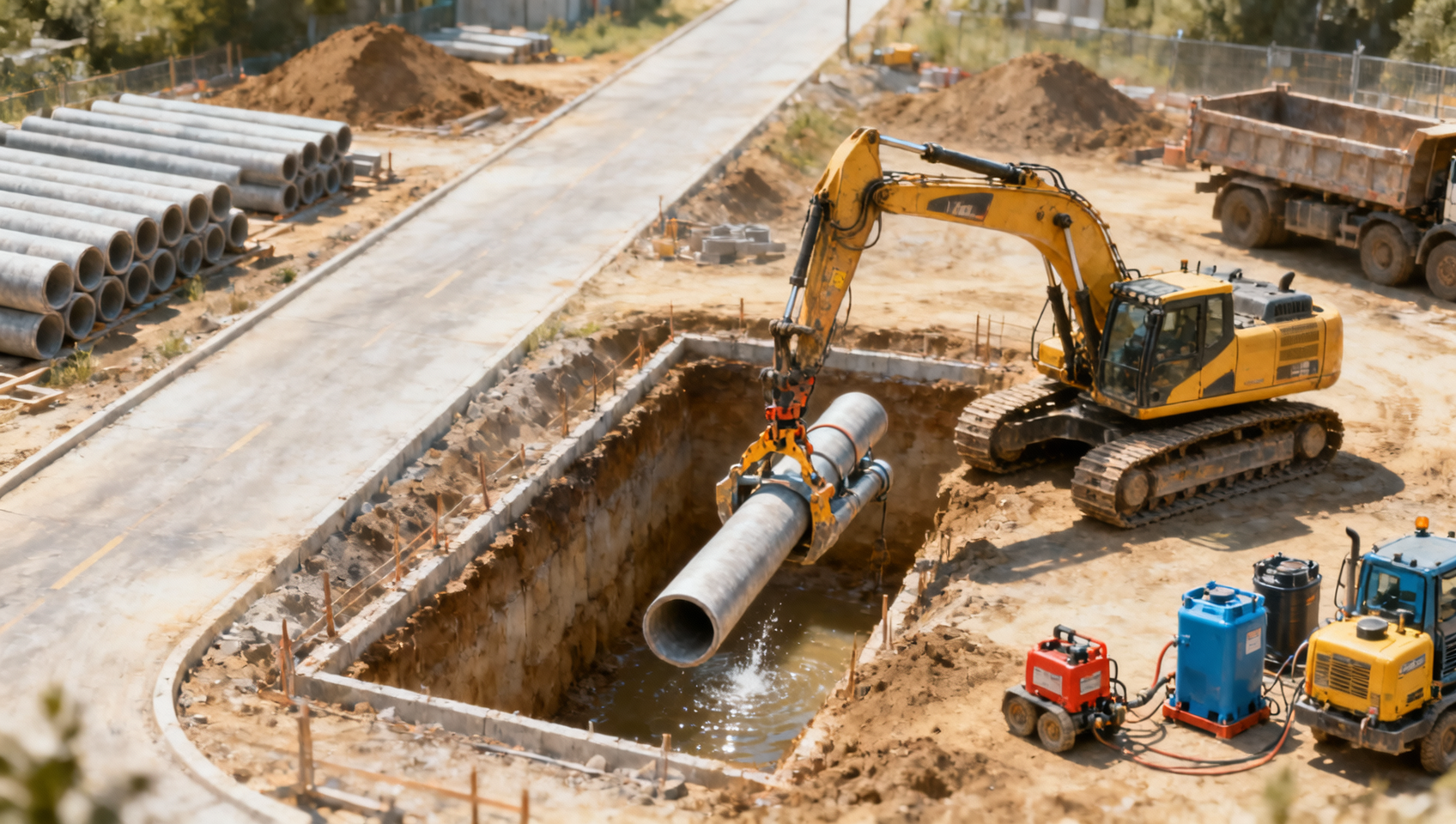
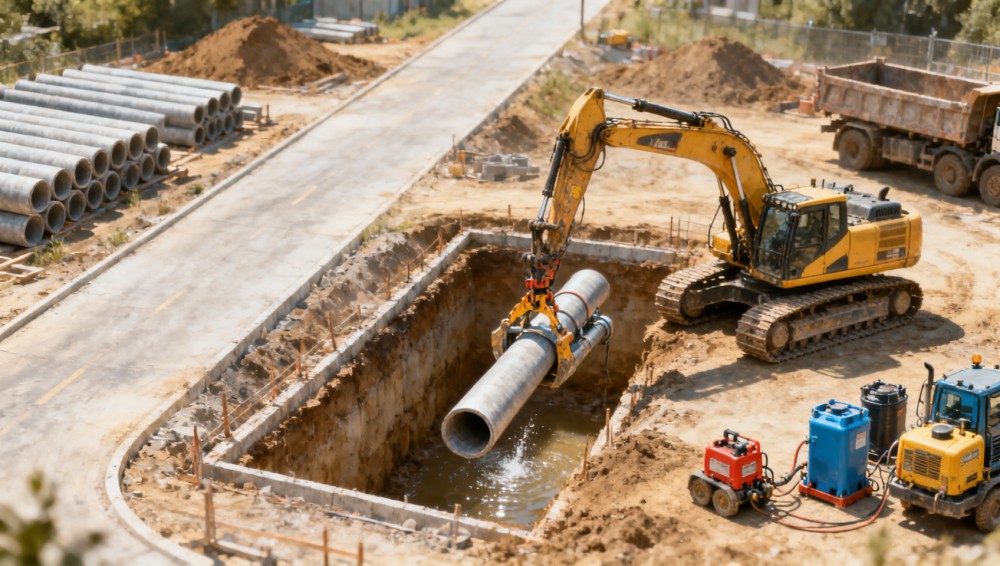
Handoffs deserve the same attention. An excavator can form a trench, but pipe installation may need lifting gear with sufficient reach and control. Backfilling may require a different bucket, a compactor matched to trench width, and test access before the next layer can proceed. If the source plan covers only the headline machine, the crew may wait on supporting equipment at precisely the point where schedule recovery is hardest.
A concise workfront matrix is often more useful than a long equipment schedule. It should connect each activity to its output, duration, operating environment, primary equipment, supporting equipment, attachments, operators, and release conditions for the next activity.
Translate productivity targets into a realistic fleet
Capacity gaps often result from treating a machine’s published capacity as project output. Actual production depends on material, operator cycle time, loading conditions, truck availability, haul distance, fuel logistics, traffic management, and working-hour restrictions. A high-capacity excavator paired with too few haul units will spend much of its time waiting. Conversely, an oversized truck fleet can create congestion at the loading point and reduce site safety.
Use the planned output to test the system, not each machine in isolation. For an earthworks operation, estimate the excavator cycle, bucket fill factor, loading duration per truck, travel and tipping time, queue allowance, and site operating hours. The result does not need to be presented as a perfect forecast. Its purpose is to show whether the excavator, trucks, dozer, grader, and water support can operate as one production system.
The same logic applies to lifting. A crane selection should begin with the heaviest lift at the required radius, but a compliant lift chart alone does not establish coverage. The team also needs to consider lift frequency, laydown arrangement, crane movement, outrigger conditions, rigging needs, wind restrictions, and whether another lift operation may occur at the same time. One crane can be technically capable of every lift and still become a schedule bottleneck.
Do not assume that buying larger equipment removes the risk. Larger units can increase transport complexity, fuel use, ground loading, exclusion-zone requirements, and idle cost. They may also be unsuitable for confined work areas. The right package is usually the one that sustains the required flow with acceptable contingency, rather than the package with the largest individual machines.
Separate core machines from the equipment that makes them usable
Coverage reviews should identify three layers of equipment. The first is the core production fleet: machines directly responsible for excavation, loading, hauling, lifting, placement, grading, compaction, or other primary operations. The second is operational support: attachments, pumps, generators, lighting, fuel storage and dispensing, access platforms, temporary roads, service vehicles, and communications equipment. The third is recovery capacity: replacement units, mobile maintenance, spare hoses and wear parts, emergency pumping, and alternative lifting or hauling arrangements.
Packages fail most often in the second layer. Attachments are especially easy to overlook because they are sometimes treated as interchangeable accessories. They are not. Bucket width affects trench productivity and overbreak. Hydraulic flow and coupler compatibility affect breaker, auger, grapple, and shear performance. Forks, lifting beams, and pipe handling attachments introduce separate load-control and inspection considerations. A supplier may provide the carrier machine quickly but need additional time to source the attachment required for the task.
Temporary power and water management deserve early attention as well. Site operations may depend on pumps, distribution equipment, backup power, fuel arrangements, hoses, discharge routing, and monitoring. A dewatering pump without suitable hoses, power, standby provision, or discharge authorization is not a complete solution. Treat these supporting systems as part of the workfront package, with defined responsibility for installation, operation, and maintenance.
Check supplier scope before comparing quotations
Two quotations with similar machine lists can represent very different delivery commitments. One supplier may provide transport, commissioning, maintenance response, certified operators, attachments, fuel support, and substitution options. Another may price machine availability only, leaving the project to coordinate haulage, inspections, breakdown response, and consumables. Neither model is automatically preferable, but the scope boundary must be visible before the commercial comparison is made.
For each equipment line, establish who is responsible for:
- delivery timing, unloading, assembly, and removal;
- operator supply, competence requirements, and shift coverage;
- pre-use inspection, maintenance, repairs, and replacement decisions;
- attachments, rigging, consumables, wear parts, and fuel or charging arrangements;
- documentation required for site entry, lifting operations, environmental controls, and local compliance;
- breakdown response time and the escalation route when equipment is unavailable.
Availability claims should be tested against the project dates and configuration required. A supplier may have an excavator in the relevant size range, for example, but not the long-reach boom, narrow trench bucket, quick coupler, or operator required for the planned work. Ask suppliers to confirm the actual unit or an equivalent substitution standard, the attachment set, maintenance status, transport lead time, and any conditions that could prevent mobilization.
Where several suppliers are involved, nominate one project-side owner for interface control. This person does not need to manage every hire order, but should maintain a single view of fleet status, critical dependencies, change requests, and incoming delivery dates. Without this control point, each procurement package can appear complete while the combined site plan remains fragmented.
Plan for variation without paying for permanent idle capacity
A package should absorb ordinary variation: weather disruption, uneven production, short maintenance stops, and minor shifts in sequencing. That does not require duplicating every machine. It requires identifying which assets are critical to the schedule, how quickly they can be replaced, and which alternatives are workable on the site.
For high-consequence equipment, define a response plan before award. A main crane, a specialized piling rig, a large dewatering pump, or a machine with a proprietary attachment may justify a named backup route, pre-agreed substitution criteria, or a service technician assigned within a defined travel area. For lower-criticality items, a local rental option may be adequate. The level of contingency should follow the cost of lost work, not an arbitrary percentage of the fleet.
Phasing also reduces unnecessary cost. Equipment should enter and leave according to the real programme, with overlap where handoffs need protection. Ending the hire of grading or compaction equipment immediately after a planned earthworks milestone may look efficient, yet leave no capacity for remedial work, utility reinstatement, or rain damage. A short, deliberate overlap can be less costly than emergency remobilization.
Use the pre-award review to expose gaps
Before issuing orders, bring the programme, method statements, site logistics plan, lift planning, temporary works requirements, and equipment schedule into one review. The objective is straightforward: for every planned activity, confirm that the required equipment can reach the work area, perform at the intended rate, operate safely in the expected conditions, and hand the work to the next trade without an unplanned wait.
Questions that uncover problems quickly include:
- Which activities cannot start if one named asset is late or unavailable?
- Which machines require attachments or support systems that are sourced separately?
- Where do equipment movements conflict with deliveries, pedestrians, cranes, or other workfronts?
- What changes when the site is wet, power is unavailable, or haul routes degrade?
- Which supplier assumptions are not reflected in the construction programme or site rules?
A construction equipment package is complete when it supports the planned sequence under credible site conditions, not when every common machine category appears on a purchase order. Treating equipment sourcing as programme design gives project managers a clearer basis for supplier discussions, a more defensible budget, and fewer surprises once crews are waiting at the workfront.
 Los Angeles and Long Beach Port Strike Deadline Pushed to Friday MidnightTime : Nov 07, 2026
 Global Supply Chain Updates: Sourcing Low-Maintenance Industrial EquipmentTime : Nov 03, 2026
- Improving Production Planning Efficiency: How to Reduce Scheduling DelaysTime : Nov 02, 2026


Industry Briefing
Get the top 5 industry headlines delivered to your inbox every morning.