
Food Manufacturing Regulations: Key Compliance Risks to Watch


Why are food manufacturing regulations getting harder to manage?
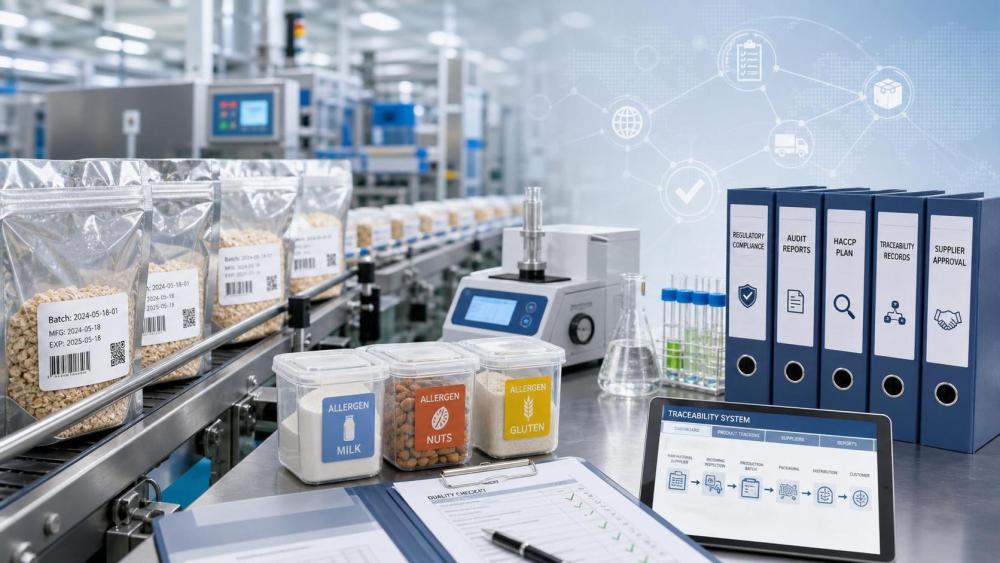
Food manufacturing regulations now reach far beyond basic hygiene and labeling. They increasingly cover traceability, supplier verification, allergen control, environmental monitoring, and digital record integrity.
That shift matters because compliance risk rarely starts with one major failure. In practice, it often begins with small gaps that stay unnoticed across production, storage, or cross-border sourcing.
A missing lot code, an outdated sanitation log, or an unreviewed supplier change can trigger much larger problems later. Recalls, detention, rework, and shipment delays usually follow documentation weakness as much as process weakness.
For industrial businesses tracking market shifts through platforms such as NEXUSINSIGHTS, the pattern is clear. Regulatory pressure moves with trade policy, equipment upgrades, and supply chain changes, not just with food safety incidents.
So when people search for food manufacturing regulations, they are often asking a deeper question. Which compliance risks are most likely to disrupt operations, and where should internal controls become tighter first?
Which compliance risks cause the most trouble during audits and inspections?
The most common trouble spots are not always the most technical ones. Inspectors usually focus on whether controls are defined, repeated consistently, and supported by records that make sense.
Several risk areas appear again and again under food manufacturing regulations:
- Incomplete traceability from raw material receipt to finished product dispatch.
- Weak allergen segregation during storage, changeover, or packaging.
- Sanitation programs that exist on paper but show poor execution evidence.
- Calibration lapses affecting metal detectors, thermometers, scales, or monitoring devices.
- Supplier approvals that are outdated, incomplete, or disconnected from actual purchasing activity.
- Label control failures involving ingredients, claims, allergens, or date coding.
Needless to say, these issues often overlap. A labeling error may reflect poor change control. A traceability gap may come from mismatched ERP data, manual paperwork, or inconsistent warehouse practices.
A useful way to judge exposure is to ask two things. Can the team prove control quickly, and can it explain deviations without searching through multiple systems?
How do food manufacturing regulations affect supplier and ingredient decisions?
This is where compliance becomes operational rather than theoretical. Food manufacturing regulations increasingly expect businesses to verify what suppliers do, not simply trust declarations.
That means supplier qualification should include risk scoring, specification review, country-of-origin checks, and change notification rules. The more complex the ingredient profile, the less room there is for informal approval.
Imported materials deserve extra attention. Regulatory expectations can differ by market, especially for additives, contaminants, pesticide limits, and labeling language. A material accepted in one country may trigger nonconformance in another.
The table below helps prioritize where supplier-side compliance risks usually sit.
A stronger process usually combines procurement data, technical specifications, and regulatory watchpoints. This matters even more when industrial supply chains stretch across several regions and contract processors.
Is documentation still the biggest hidden risk?
In many facilities, yes. Documentation is often treated as proof after the fact, but regulators treat it as part of the control itself.
If records are late, inconsistent, or manually corrected without review, confidence drops quickly. Even when the physical process is stable, weak records suggest the system may not be reliably managed.
The hidden risk grows during expansion, automation upgrades, or line modifications. New sensors, packaging equipment, and ERP integrations can improve control, but they also create data handoff points where records stop matching.
More common warning signs include missing signatures, unclear corrective actions, duplicate forms, and retention periods that differ by department. These do not look dramatic, but they create real audit exposure.
A better question is not whether forms exist. It is whether records can reconstruct what happened, who approved it, and how the issue was closed.
What should a strong record system prove?
- The control point was monitored at the required time.
- The result met the defined limit or triggered action.
- The deviation was investigated, not merely noted.
- The correction prevented release of unsafe or mislabeled product.
- The review process confirmed closure and trend visibility.
Where do teams misread food manufacturing regulations during implementation?
One common mistake is assuming certification equals full compliance. Standards such as HACCP, BRCGS, SQF, or ISO-based systems help structure controls, but legal requirements still depend on market, product, and claim.
Another mistake is over-focusing on the production floor. Food manufacturing regulations also reach packaging artwork, warehouse practices, transport conditions, supplier files, and complaint handling.
There is also a timing issue. Businesses often review regulations only before an audit, a customer visit, or a shipment launch. By then, corrective action becomes more expensive and less flexible.
In actual operations, a more reliable approach is to map obligations into routine decisions. New equipment validation, cleaning verification, line changeovers, and export planning should all carry regulatory checkpoints.
That is why cross-functional visibility matters. Industrial information platforms such as NEXUSINSIGHTS are useful when tracking policy updates, supply chain signals, and equipment trends that may change compliance assumptions.
What is the most practical way to reduce compliance risk without slowing production?
The goal is not to add paperwork everywhere. It is to build controls where failure is costly, likely, or hard to detect early.
A practical roadmap often starts with a short internal review across process, records, suppliers, and labels. From there, risk ranking becomes easier and resource use becomes more targeted.
- Test traceability with timed mock recalls, not only annual paperwork reviews.
- Review allergen changeovers where shared equipment or rework is involved.
- Align specification files, purchasing data, and label content in one approval flow.
- Check calibration and preventive maintenance against food safety critical points.
- Monitor regulatory changes by market, especially before export expansion.
- Trend nonconformances to find repeated weak signals before they become incidents.
The best systems usually look simple from the outside. They reduce manual interpretation, clarify ownership, and make proof available quickly during an inspection or customer request.
Food manufacturing regulations will continue to evolve with trade complexity, digitalization, and tighter safety expectations. The safer move is to treat compliance as an operating discipline, not a document exercise.
A sensible next step is to review the highest-risk products, map the controls that support them, and compare those controls against current records, supplier files, and market-specific rules. That usually reveals where action is needed first.



Industry Briefing
Get the top 5 industry headlines delivered to your inbox every morning.