
How to Vet an Industrial Machinery Supplier in Germany Before Signing a Contract

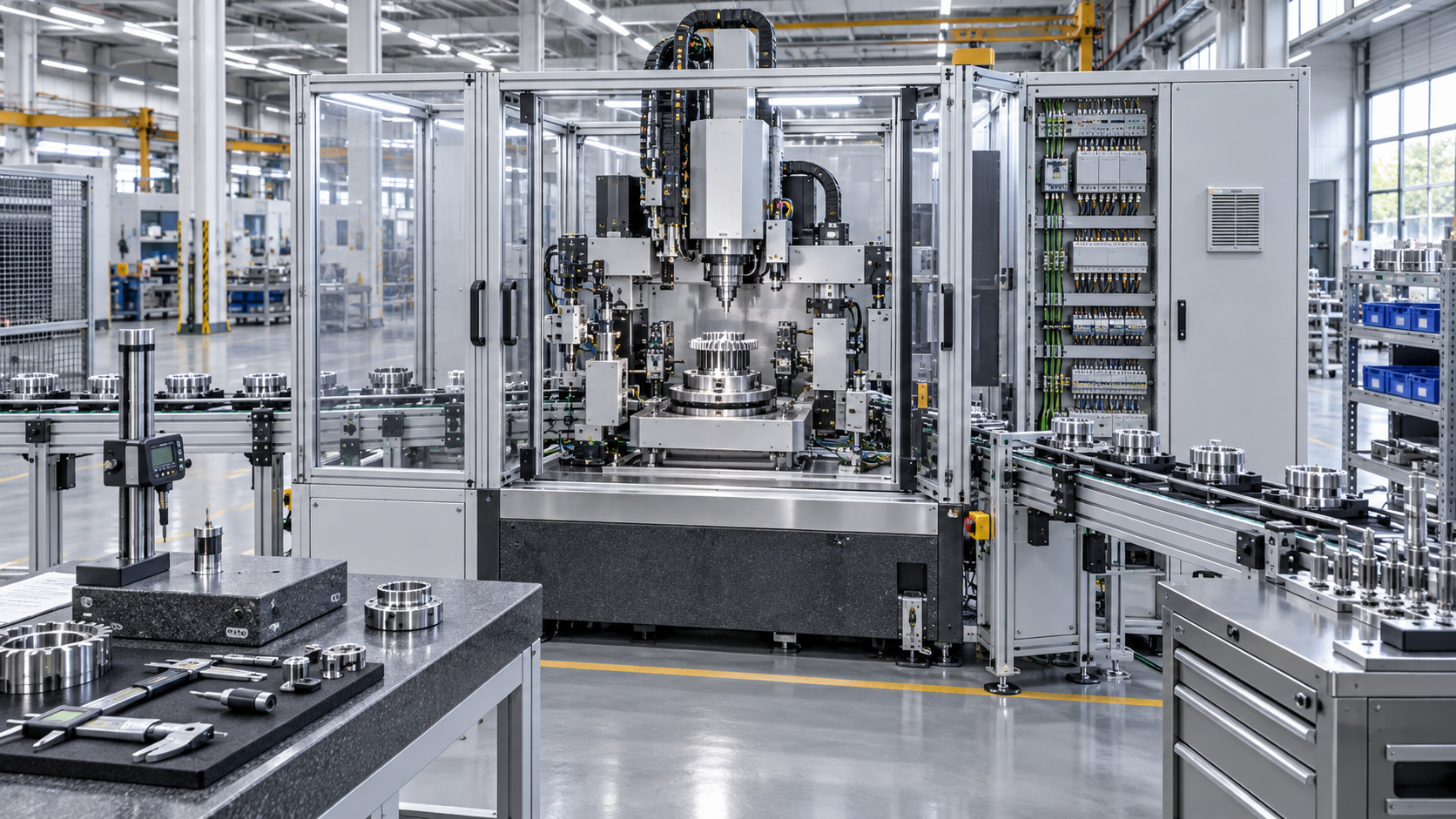
A low quotation can hide the most expensive part of an industrial machinery purchase: an unclear technical scope that turns into redesign, delayed acceptance, disputed performance, or unavailable support after commissioning. Before signing with an industrial machinery supplier in Germany, compare the offered machine against the actual production duty, then test whether the supplier can document every claim that affects output, uptime, compliance, and total installed cost.
Start with the application rather than the catalogue model. A machine described as suitable for a material, process, or throughput range may still be unsuitable at the operating limits. Feedstock variation, ambient temperature, abrasive dust, shift pattern, product-change frequency, required surface finish, and available utilities all influence the correct configuration. The supplier should respond to these conditions with a defined technical proposal, not a broad assurance that the standard machine will work.
Turn the quotation into a verifiable technical scope
Ask for a controlled specification that identifies the machine configuration offered, including principal assemblies, installed drives, controls architecture, guarding, measuring devices, tooling interfaces, and included auxiliary equipment. Generic descriptions such as “high-performance drive,” “premium hydraulics,” or “complete automation package” do not establish what will be delivered. The proposal should name the function, capacity, interface, and responsibility for each relevant item.
Capacity figures deserve particular scrutiny. A stated hourly output may refer to a best-case cycle with no loading delay, no material variation, and no quality rejection. For a press, the meaningful question is whether force is available through the required part of the stroke and at the working speed. For a machining center, spindle power alone says little without torque at the intended speed, axis acceleration, workholding limits, tool-change time, and chip evacuation conditions. For conveying or process equipment, nominal throughput should be separated from sustained throughput at the actual bulk density, moisture level, particle size, or product geometry.
Require the supplier to state the assumptions behind each performance commitment. If the proposed output relies on customer-supplied fixtures, a specific material grade, stable compressed-air pressure, or manual intervention between cycles, include those assumptions in the contract documents. Otherwise, an acceptance dispute can become an argument about conditions that neither side formally recorded.
Distinguish machine limits from process limits
A supplier may correctly state that a machine can reach a given speed while the complete cell cannot achieve the same rate. Robot pick-and-place time, barcode validation, cooling, inspection, pallet exchange, downstream accumulation, and operator access can become the actual bottleneck. Review the proposed layout as a system. Confirm product flow, buffer capacity, material presentation, reject handling, maintenance access, electrical cabinets, lifting paths, and the space needed to remove large wear parts.
Installation conditions should be documented early. Floor loading and anchoring requirements, vibration sensitivity, ceiling clearance, extraction connections, drainage, cable routing, network access, compressed air quality, cooling-water characteristics, and local voltage details are often treated as site matters until commissioning approaches. A technically sound machine can still incur significant cost and delay when these interfaces are left undefined.
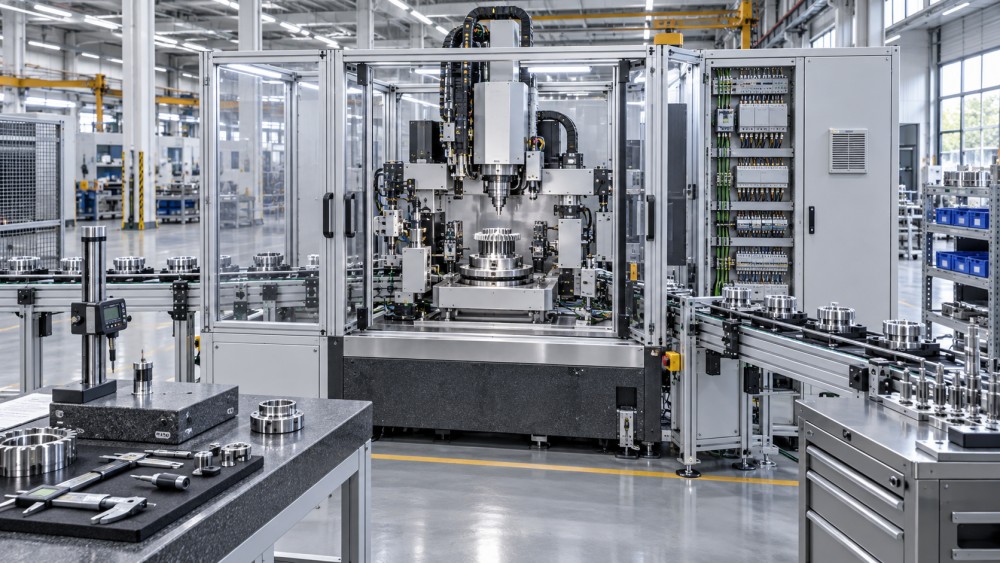
Test engineering capability through evidence, not presentation material
Germany has a strong industrial equipment base, but supplier capability varies sharply between a manufacturer that designs and controls the critical assemblies and a commercial entity that integrates externally sourced modules. Either model can be viable. The difference matters because it affects engineering authority, spare-parts availability, fault diagnosis, and the ability to modify a machine after delivery.
Ask which components are designed, manufactured, assembled, programmed, and tested internally. Focus on parts that determine the intended process: the frame or machine bed, spindle or forming unit, pressure system, safety control, software logic, motion system, thermal control, and critical tooling. When major elements are sourced externally, establish who owns the interface and who is responsible if the combined system misses the agreed performance.
Technical drawings and documents reveal useful details. Review the general arrangement drawing, utility schedule, process flow, electrical architecture, pneumatic or hydraulic circuit where relevant, and bill of included items. These documents do not need to expose proprietary design information to be useful. Their purpose is to confirm that the proposed solution has progressed beyond a sales description and that interfaces are being managed deliberately.
Where custom engineering is involved, examine revision control. A supplier should be able to identify the version of the specification, drawings, software configuration, and approved deviations. Informal changes made through email or meeting notes are a common source of later disagreement, especially where a change affects safety guarding, cycle time, tooling, or connected equipment.
Inspect quality control where failures are most likely to originate
Quality-system certificates can support confidence, but they do not prove that a specific machine will be built correctly. Direct the review toward the controls that apply to the proposed equipment. For welded structures, ask how material traceability, weld procedures, dimensional inspection, stress relief where applicable, and machining alignment are managed. For precision motion equipment, examine assembly cleanliness, bearing installation methods, backlash verification, alignment records, and calibration routines.
Electrical panels and software deserve equal attention. Confirm how wiring is inspected, how safety circuits are validated, how software versions are controlled, and whether a backup of the delivered configuration is included. A control system assembled from reputable components can still be difficult to maintain if terminal documentation, I/O lists, parameter backups, and fault histories are incomplete.
Factory testing should reflect the intended duty. A no-load demonstration may confirm motion but cannot establish cutting quality, thermal stability, sealing performance, product handling reliability, or automated recovery after a fault. Define a factory acceptance test around measurable results that matter to the process. These can include dimensional repeatability, output over an agreed run, energy consumption under stated load, leakage, noise, rejection logic, or changeover function. The test material, tooling, operators, instrumentation, and pass criteria should be identified before the machine enters final assembly.
Verify legal, commercial, and financial standing separately
Technical competence does not remove commercial exposure. Confirm the legal entity that will sign the contract, receive payment, issue invoices, provide warranties, and carry responsibility for the supplied equipment. The trading name used in marketing material may differ from the contracting entity. Contract documents should show the full legal name, registered address, authorized signatory, and applicable tax and registration details.
Use current official corporate information and request a clear explanation of the ownership and operating structure where it affects performance. A small engineering firm can be an excellent supplier, but a large advance payment tied to a long custom build requires a different level of scrutiny than a stocked standard machine. Review whether the payment milestones correspond to observable value: approved design, completed fabrication, successful factory acceptance, shipment, installation, and final site acceptance.
Do not treat a bank detail change as routine administration. Verify changes through a known contact using an independently confirmed communication channel. The same discipline applies to requests for accelerated deposits, altered shipment instructions, or replacement contractual documents late in the negotiation.
Compliance statements should be relevant to the delivery destination and machine configuration. Ask what documentation will accompany the equipment, who prepares it, and what duties remain with the importing party or site owner. Where machinery is integrated into an existing line, responsibility for the complete installation, safety interfaces, emergency stops, and guarding boundaries must be explicit. A declaration covering an individual machine does not automatically resolve obligations for the assembled production cell.
Examine delivery, commissioning, and support before pricing the contract
Delivery terms need more detail than a stated lead time. Identify the point at which risk transfers, who arranges export packing, whether sensitive components require preservation or climate protection, and who is responsible for loading, inland transport, customs documents, unloading, positioning, and disposal of packaging. Large machinery may require a route survey, special lifting equipment, temporary access changes, or a foundation ready before arrival. These items often sit outside the machine price yet determine whether the installation date is realistic.
For equipment shipped partly disassembled, require a packing list linked to assembly drawings and a statement of what is preassembled, removed for transport, or supplied as loose accessories. Missing sensor brackets, cable carriers, fasteners, lubrication lines, or special tools may not stop shipment but can delay commissioning substantially.
After-sales capability should be reviewed in operational terms. Ask where service personnel are located, whether remote diagnostics are available, how access is managed, what languages are supported in manuals and service communication, and which failures require an on-site visit. The important issue is not a general promise of global support. It is whether the likely failure modes of the proposed machine can be diagnosed and corrected within an acceptable outage window.
Spare-parts planning should follow criticality rather than a blanket request for an extensive package. Long-lead electronic modules, proprietary sensors, seals, bearings, high-wear tooling, and safety devices may deserve initial stock. Common items readily available through local industrial distribution may not. Request parts lists with manufacturer references where possible, recommended holding quantities, expected service life assumptions, and any items that require factory programming or pairing.
Make acceptance and warranty terms operational
The contract should separate factory acceptance, delivery inspection, installation completion, site acceptance, and warranty commencement. These events are often compressed into a single phrase, leaving uncertainty about payment release and corrective work. Each stage should have an agreed record: test procedure, result sheet, punch-list format, responsible party, deadline for correction, and the effect of unresolved deviations.
Performance guarantees need an agreed measurement method. If availability is relevant, define planned stops, operator-caused stoppages, material shortages, and upstream or downstream failures. If product quality is relevant, define sampling method, tolerances, inspection equipment, and treatment of start-up pieces. Without this structure, both parties can use different calculations while believing they are discussing the same result.
Warranty language should identify the remedy for defective parts, workmanship, software defects, and repeated failures. Clarify whether labor, travel, freight, customs charges, removal, reinstallation, and production interruption are included or excluded. Also preserve the right to receive updated drawings, software backups, parameter files, and service records after corrective work. A repaired machine is harder to maintain when the documentation no longer matches its delivered state.
Before signature, consolidate the final offer, technical specification, approved drawings, acceptance procedure, commercial schedule, documentation list, and written deviations into the contract hierarchy. This is where a credible industrial machinery Germany supplier becomes distinguishable from a merely persuasive one: the promised machine, proof method, responsibilities, and recovery path are all clear enough to be administered when conditions are no longer ideal.
 Circuit Protection Equipment Export Markets: Where Is Demand Growing?Time : Nov 06, 2026
 China Tightens Technology Export Controls, Leveraging Industrial StrengthTime : Nov 04, 2026
- Is Factory Automation Essential for Competitive Export Manufacturing?Time : Nov 02, 2026


Industry Briefing
Get the top 5 industry headlines delivered to your inbox every morning.